TL;DR
Soundcore's Liberty Buds offer a unique blend of features beyond just sound, including cutting-edge Bluetooth 6.1 for enhanced privacy and efficiency, and impressive AI-powered real-time translation tools. While their design eschews traditional ear tips for a more open fit secured by stabilizing wings, and the adaptive ANC is potent, it's not adjustable. The audio profile leans towards bass-heavy, potentially fatiguing for audiophiles but engaging for casual listening. If you're looking for a feature-packed gadget with advanced translation capabilities rather than pure high-fidelity audio, these might be worth a closer look. Dive in to see if this tech-forward package is right for you.
We hardly need to introduce Soundcore in the same way we did when we tested their Soundcore Sport X10 back in September 2022. Soundcore has become increasingly visible and common in most major electronics stores across the country. Soundcore typically offers innovative technological solutions and interesting features, and Anker Soundcore Liberty Buds are no exception. They aren’t the cheapest headphones on the market, but they include several details that we haven’t seen from competitors yet.

(Photo: senses.se)
First Impressions – Anker Soundcore Liberty Buds
The first thing we react to is the name, Liberty Buds, because it is actually starting to get a bit confusing. Liberty appears in quite a few variants: Soundcore Liberty 4 and Liberty 4 NC. We also have Soundcore Liberty 4 Pro and the newcomer Soundcore Liberty 5. But the ones featured in this test are called Soundcore Liberty Buds. Exactly how these are related or if there is a specific order feels a bit unclear, unlike the Sleep series with Sleep A20 and A30. Or the previously mentioned Sport X10, which has a successor named Sport X20. In those cases, it is very clear.
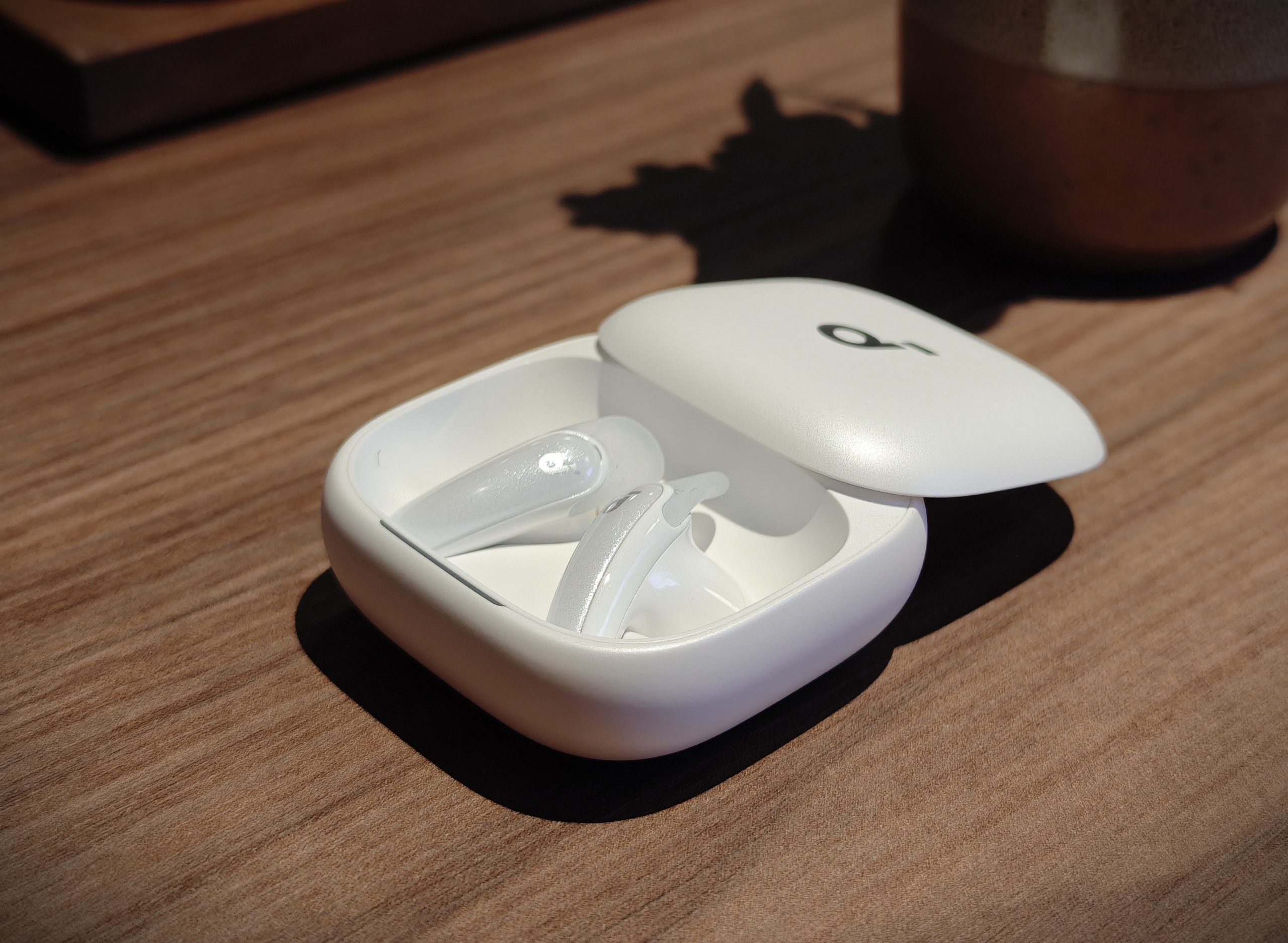
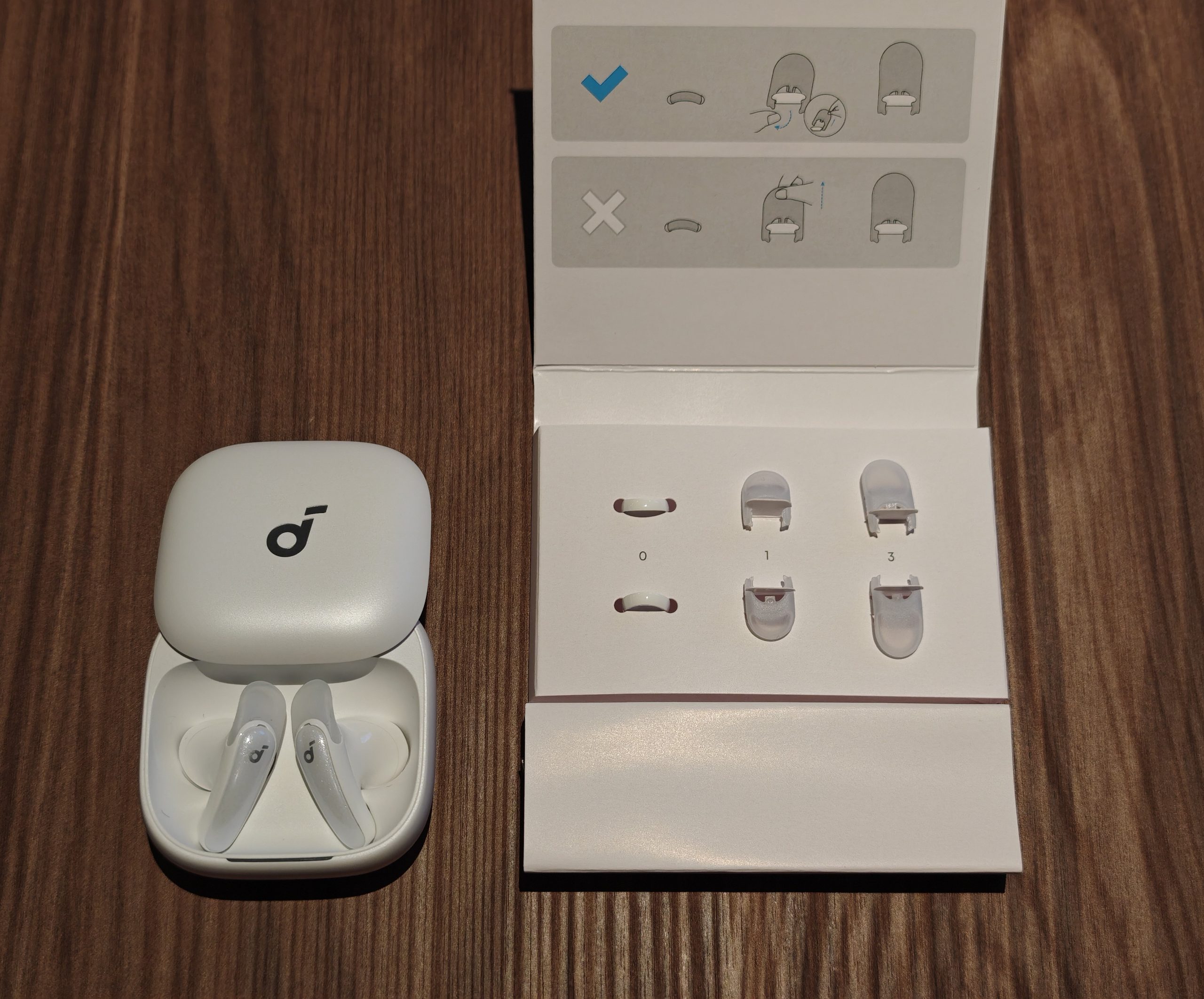
And it’s not just the name. Previous Liberty earbuds have been of the in-ear format with silicone tips that seal in the ear. With Liberty Buds, the design is more similar to a pair of AirPods, where the earbud is made entirely of hard plastic. In other words, no tips. For some, Apple’s solution has felt a bit insecure as nothing “gripped” the ear; instead, they simply rested there. Soundcore seems to have caught wind of this and added a wing on top of the earbud that locks it more securely into the ear. The wing comes in three different sizes, but you also get a half-ring that removes the concept entirely. The wing works well, however; not only does it hold the earbud in place, but it also helps you position it correctly in the ear.
(Photo: senses.se)
The charging case is relatively similar to many predecessors and suffers from the same issue of being so light and symmetrical that it isn’t entirely easy to feel which way the lid should slide.
Bluetooth 6.1
Soundcore Liberty Buds are likely the first headphones we’ve tested that feature Bluetooth 6.1, so let’s take a quick look back and explain what the new version entails.
Bluetooth 5.0 arrived in 2016, and it was with this version that Bluetooth became fast and gained a significantly higher range. All versions since then have solved specific problems that later versions have utilized alongside further discoveries. One example is version 5.2, which gave rise to LE Audio (Low Energy Audio), which, simply explained, enabled the same or improved sound with lower bandwidth, thus saving battery life. Moving forward to September 2024, version 6.0 was released. The big thing with that version was the ability, through Channel Sounding, to let devices measure the distance between each other with centimeter precision, allowing a car, for example, to unlock when you are within a predetermined distance. And for all this traffic, Bluetooth Low Energy was used—the same as LE Audio.
Then we come to Bluetooth 6.1, released in May 2025. The central components of the new version are enhanced security and energy efficiency. So-called RPA (Random Private Addresses) reduce the possibility of tracking the user, as the addresses in 6.1 change randomly at an interval of 8 to 15 minutes instead of statically changing every quarter-hour. The address is also changed directly in the Bluetooth chip without involving the host device to minimize battery usage on the earbud or smartwatch.
In other words, Bluetooth 6.1 does not affect the sound but makes the system more energy-efficient and harder to track.

(Photo: senses.se)
Adaptive ANC 3.0
Our first concern with the earbuds not having silicone tips was ambient noise. However, it turned out that the noise cancellation is surprisingly effective. The earbuds need a moment to pick up the ambient sounds and then block them. The sounds that slip through are sudden noises, as the adaptive noise cancellation can’t keep up, and high frequencies tend to penetrate continuously. The downside of adaptive noise cancellation is that it is constantly working and adjusting to the surroundings. This is fine if there is a relatively constant curtain of sound around you, but otherwise, quite a lot is happening, which also negatively affects the soundstage. You have to wait until the process is finished to hear if both earbuds are seated correctly. Until then, it feels “messy” in the ears and the sound is uneven. If you turn off the noise cancellation, it’s as if the earbuds slowly build up the sound; it fades in, so to speak. So even then, you have to give them a few seconds before everything is in place.
The noise cancellation is also powerful—so powerful that the classic pressure in the ear arises after a while. Unfortunately, unlike previous models or some competitors, you cannot adjust the level of noise cancellation; it’s either full power or nothing at all.
Instant Translation with Soundcore’s AI Anker
When this review of the Liberty Buds was written, three translation variants were in place: Real-Time Translation, Face-to-Face Translation, and Contextual Learning. A fourth variant has an empty box and is expected at some point in the future. What it is and when it will arrive is currently unknown.
Real-Time Translation
This feature allows you as a bystander to follow conversations in other languages. We have tested English, French, German, Persian, and some Chinese. The interpretation of what is being said is written in the app, and the translation is read aloud in the earbuds. Over a hundred languages are supported, and it is even supposed to be able to determine for itself which language it is hearing, which works moderately well. But if you know which language is being spoken, it works really well. Challenges arise, of course, when sentences are interrupted or if slang is used. But if you follow along in the app, you can see when things get a bit off. It’s not one hundred percent, but Soundcore has always been an early adopter of features that needed a little polish—like how AI-generated soundscapes couldn’t be played without the phone in Sleep A20, or that Liberty 4 measured your heart rate in your ears, which didn’t always sync with heart rate monitors. However, we performed two translations and saved them below. One is from Sveriges Radio Ekot and the other from the opening scene of Casino Royale from 2006, so you can see for yourselves how accurate it is.


Face-to-Face Translation
This feature is simply translation. You speak a sentence, the app translates it, and plays it back. The difference is that everything said is played through the phone and not in the earbuds, so your counterpart is aware of what’s happening.
Contextual Learning
This feature consists of a library of phrases divided into subject areas. Examples like “Can I have the check?”, “Where is the nearest subway?” or “Can you recommend a dish?”. You get the idea—what used to be in those small books people carried around has been moved to the app. The core functionality isn’t new by any means, but if you have a pair of Liberty Buds, it’s close at hand.
Now that we’ve gone through some of the Liberty Buds’ more outstanding features, it’s time for the most important part: the sound. So, how do they sound?
The Soundstage – Anker Soundcore Liberty Buds
You get a powerful soundstage with the 11 mm dynamic drivers. Powerful and somewhat exaggerated. The bass registers are very prominent, which is effective but hardly neutral, making it a bit tiresome in the long run. We experienced something similar with Beyerdynamic Amiron 100, where the listener never got a breathing room—it was full throttle all the way. The Soundcore Signature preset EQ was used throughout the first rounds with our test playlist, and it’s not bad sound. But when we switch to Beyerdynamic Amiron 300 or Technics EAH-AZ80, the differences become apparent. Granted, Technics is in a higher price bracket and Amiron 300 is roughly the same, but the comparison shows which parts are missing. Detail, breadth, and dynamics are areas where Soundcore Liberty Buds do not perform at the top level.
However, Liberty Buds are good at separating frequency ranges and delivering punch where needed. Hans Zimmer – Buyer Beware is entertaining to listen to, even if the driving sub-bass presses a bit too much against the eardrums. Softer pieces like Apparat – Goodbye become a bit dull as the earbuds don’t really perform when full intensity isn’t required. As with Trevor Guthrie – This Is What It Feels Like, Soundcore Liberty Buds perform very well.

(Photo: senses.se)
The Bottom Line – Anker Soundcore Liberty Buds
It is a balancing act between focusing on the sound and simultaneously including all sorts of technical features. Headphones like Technics EAH-AZ100 focus on the sound and sound accordingly (even if Technics still stands alone with triple-point connectivity). Liberty Buds include an arsenal of features that don’t really have to do with listening, making the headphones more of a tool than a source of high-fidelity audio.
As long as one is aware of that distinction, you can take the headphones for what they are. Liberty Buds cost 1,700 SEK, which does not place them in the lower price bracket. And they are not the best-sounding either. But they come with translation tools, the latest Bluetooth version, advanced noise cancellation, and a decent soundstage. So if sound is the focus, these are not our primary choice. But if the goal is meaningful features, Liberty Buds rank relatively high on the list. However, we think 1,700 SEK is a bit on the high side given the negative aspects we discovered. Even though some technical features shine, the overall impression isn’t quite as high.
Soundcore sent review copies for this test. Senders of material have no editorial influence on our tests; we always write independently with you, the readers and consumers, in focus.
Review Highlights: Q&A
What is the design of the earbuds?
They are hard plastic without silicone tips, similar to AirPods.
How do they stay secure in the ear?
They use a wing on top of the earbud that comes in three different sizes.
What unique translation features are included?
Real-Time Translation, Face-to-Face Translation, and Contextual Learning.
Can I adjust the noise cancellation level?
No, you cannot adjust it; it is either at full power or turned off.
How does the sound quality perform?
It is powerful with heavy bass, but lacks detail and is not neutral.
What version of Bluetooth do these earbuds use?
They feature Bluetooth 6.1 for better security and energy efficiency.
What is the price of the Soundcore Liberty Buds?
They cost 1,700 SEK, which is considered a bit high for the quality.
What is the main issue with the charging case?
It is so light and symmetrical that it's hard to feel how to open the lid.
