TL;DR
The Samsung Galaxy Watch 9 is a powerhouse of performance and health tracking, featuring a stunning 3,000-nit screen and the fastest processor we’ve ever tested in a wearable. With a sleek, lightweight design and industry-leading update support through 2031, it’s a compelling choice for Android enthusiasts. Its health suite is massive and subscription-free, offering remarkably accurate heart rate and GPS data. However, the watch is held back by two major flaws: a battery that demands daily charging and a slow 100-minute recharge time. Furthermore, premium features like ECG and sleep apnea detection remain frustratingly locked to Samsung smartphone owners. Is the gorgeous hardware and class-leading software enough to offset these recurring battery woes and ecosystem restrictions? Find out if this is your next must-have upgrade in our full review.
Samsung is the manufacturer that has stuck with Wear OS the longest, and over the years, the Galaxy Watch series has become the obvious reference for many Android users. Now we have tested the latest model, Samsung Galaxy Watch 9 in the 44 mm version.
On paper, most things look really good: a new and faster processor, one of the brightest screens on the market, dual-band GPS, and a health package that is broader than that of virtually all competitors.
It has actually been a while since we had a Samsung watch at the office. The last time was in 2022, and back then it was the Galaxy Watch 5. Although we liked it a lot, it got stuck at “only” a seven for three reasons: battery life, slow charging, and the fact that several health functions required a Samsung phone. Has anything happened in four years? We’re going to find out!
Design and build quality
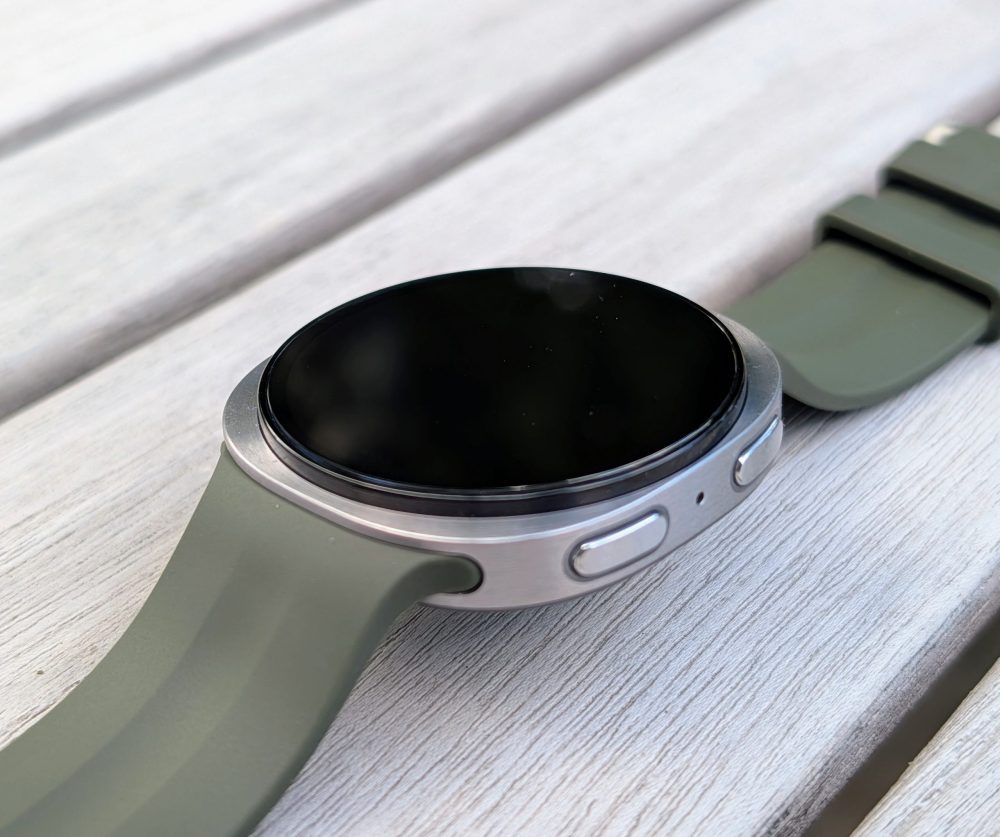
Galaxy Watch9 is quite simply a good-looking watch. The round dial is set in an aluminum case, square with heavily rounded corners, and the proportions are well-balanced. The dimensions are 46.0 x 43.7 x 8.6 mm and the weight lands at 34 grams without the strap. This makes it one of the lightest and thinnest watches in this class, and the difference compared to, for example, the Xiaomi Watch 5 at 56 grams is immediately noticeable on the wrist.
The watch fits very well. The included sport band is soft and flexible, and the new band attachment makes changing straps a breeze. Sleeping with the watch is no problem at all, and after a while, you don’t even notice it’s there. That’s exactly how it should be for a watch meant to be worn 24/7.
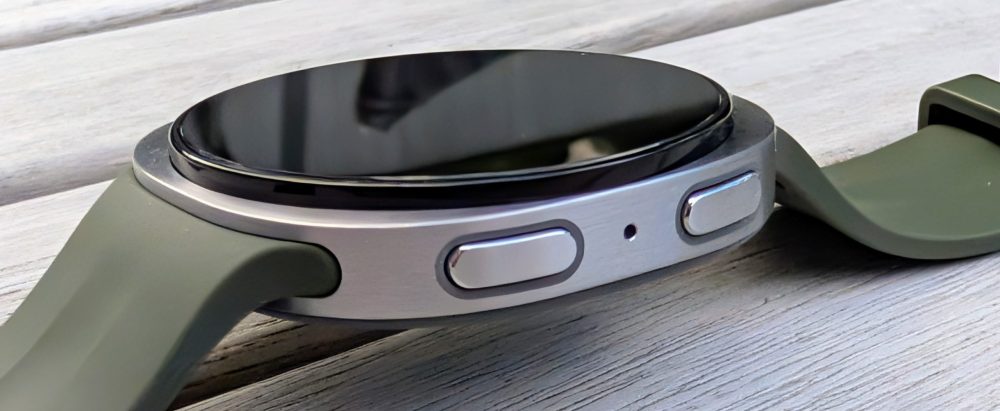
On the right side are two buttons and on the left is a speaker grille. The glass is sapphire crystal, and the durability is 5 ATM combined with IP68 and MIL-STD-810H. This means that showering and swimming work perfectly, but it is not a diving watch.
If there is anything to complain about, it is that the design is very close to its predecessor. There is also no physical rotating bezel on this model; instead, you have to settle for the digital frame along the edge of the screen. It works, but the tactile precision that a real crown or bezel provides is missing.
Screen
The screen is quite simply fantastic. We’re talking about a 1.5-inch Super AMOLED with 480 x 480 pixel resolution and a peak brightness of 3,000 nits.
In practice, this means the screen is razor-sharp and readable in just about every situation, including direct sunlight. The colors are great, the blacks are deep, and there is no dead space to speak of around the panel. This is one of the best screens we have seen on a smartwatch, and it alone elevates the entire impression of the product. Always-On Display is, of course, available, but more on what that costs further down.
Performance
Under the hood sits Qualcomm’s Snapdragon Wear Elite, a five-core 3 nm chip at 2.1 GHz plus 1.95 GHz, along with 2 GB of RAM and 32 GB of storage.
And it shows. The watch is extremely fast and responsive. Apps start instantly, menus slide by without stuttering, and it doesn’t matter if you’re switching between Spotify, Google Maps, and a workout view. During the entire test period, I haven’t experienced it lagging even once. This is the fastest smartwatch I have ever used.
Software and updates
Galaxy Watch9 runs Wear OS 7 with Samsung’s own One UI 9 Watch on top, and it’s a combination that works really well. You get full access to the Play Store, Google Wallet, Google Maps, and Gemini, while Samsung adds quite a bit that actually improves the experience.
Notification management is a good example. Notifications are grouped by app instead of trickling in one by one, making the entire list significantly more organized than on most other Wear OS watches. Also new is the Now Bar, a small indicator at the bottom of the screen that provides a shortcut back to whatever is happening in the background, such as a run or music playback. Tiles are now stacked vertically, which is also an improvement.
Gemini is built-in and can be activated by raising your wrist to your mouth and starting to talk, without a wake word. It works well, but Samsung itself points out that the feature drains more battery because sensors and the microphone must be on standby at all times. Given the battery situation (which we will get to), it’s something to consider.
One thing worth highlighting is the update support. Samsung promises five OS upgrades and security updates until July 31, 2031. This is by far the best in its class and something quite different from what several competitors offer. If you buy this watch, you’ll be able to keep it for a long time, and that’s an argument that carries more weight than you might first think.
On the downside, the AI-generated health insights in the app are quite bland. They rarely say anything you didn’t already know. You also have to activate several of the health functions manually in the app; there is no guide to take you through it at startup.
Health and fitness
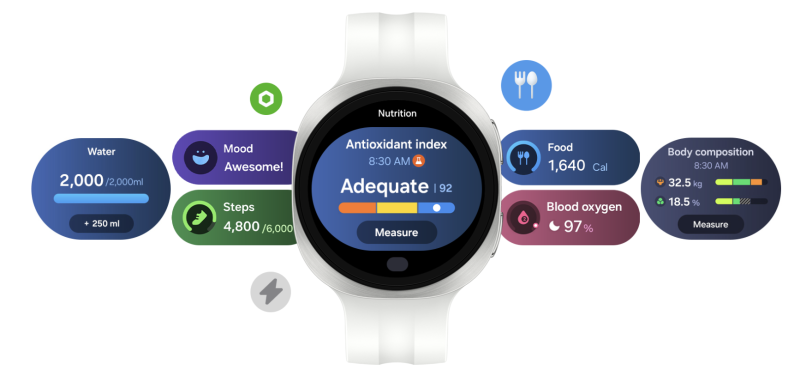
This is where the Galaxy Watch9 is really strong. The sensor suite consists of an optical heart rate sensor, electrical heart sensor, BIA for body composition, skin temperature, accelerometer, gyroscope, barometer, compass, and light sensor.
The amount of metrics is almost overwhelming. Under Vitals, you’ll find heart rate, HRV, respiratory rate, blood oxygen levels, and skin temperature, and after seven nights, the watch builds a personal baseline and warns you when something deviates. Also found there is vascular load, which is measured overnight and says something about how stiff your vascular system is.
Beyond that, there’s a heart health score, Energy Score which combines sleep, stress, and activity into a daily readiness figure, daily fitness load, fitness index, sleep coaching, and Antioxidant Index, where you place your thumb on the sensor for five seconds to measure the carotenoid level in your skin. There is also an AGEs Index linked to metabolic aging, and a Running Coach that builds an individual three-to-five-week training program after a test run. The latter, however, is still marked as beta.
Best of all: none of this is behind a subscription. At a time when several competitors are locking analyses behind monthly fees, this is worth a lot.
The heart rate measurement is what impresses most. I have compared it against a chest strap during walks, running, and harder intervals, and the curves follow each other almost exactly. There are none of the lags or lock-ups at the wrong heart rate value that you sometimes see on optical sensors during high-intensity training.
The GPS is also top-class. The watch supports dual frequency bands (L1+L5) along with GPS, Glonass, Beidou, Galileo, and QZSS. I have tested it on routes I know well, both in the city and in the woods, and the tracks are precise. The position is also locked quickly.
But what really stands out is the automatic workout detection. It is quite simply the best I have tested. Walks, runs, and swims are picked up automatically, quickly and without you having to think about it. This is something most watches can do, but not this smoothly or precisely. It’s not just how they start, but pauses and endings are handled perfectly.
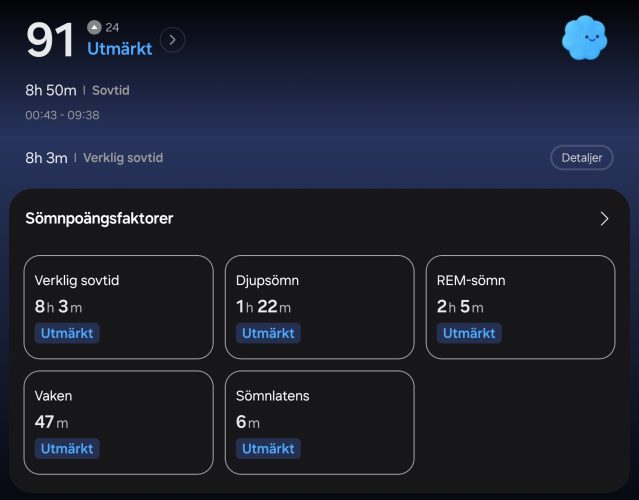
Sleep analysis also feels good. It’s always hard to know how accurate the various sleep stages actually are, but the watch registers when you fall asleep, when you wake up, and awake moments during the night in a way that matches reality. Above all, you avoid the “false sleep” that, for example, the Xiaomi Watch 5 suffers from, where the watch registered sleep while I was just sitting on the couch.
Features that require a Samsung phone
And then there’s this. This section deserves to stand on its own, because it is the single biggest objection to the watch for anyone who doesn’t already have a Galaxy phone.
The dividing line isn’t between features but between two apps. Samsung Health is available in Google Play and works on any Android phone. Samsung Health Monitor, on the other hand, is only in the Galaxy Store, and it can only be installed on a Samsung phone. Everything in that app is therefore locked.
This involves four health functions:
- ECG
- Blood pressure measurement
- Irregular Heart Rhythm Notifications (IHRN), which runs in the background and can flag atrial fibrillation
- Sleep apnea detection
In addition, there are a number of small things like syncing Do Not Disturb and Sleep Mode between the watch and phone, Samsung Wallet, camera control from the watch, and birthday notifications in the calendar.
There is no technical reason for this. The app could easily be on Google Play. It is a pure business decision on Samsung’s part, and it is a very poor one. If you buy a watch for nearly 5,000 SEK, you shouldn’t have to buy the right phone brand as well to access hardware that is already in the product.
Notifications, workout tracking, apps via the Play Store, fall detection, and emergency calls, however, work just as usual regardless of which Android phone you have.
And as always with Wear OS: the watch does not work with iPhone at all.
What about blood pressure?
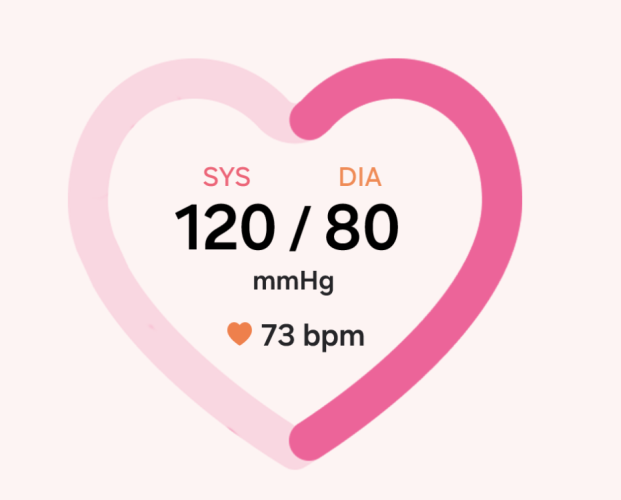
Blood pressure measurement is one of the functions that is approved for the Swedish market, unlike in several other countries, so it works here. But it requires quite a bit from the user.
First, the watch must be calibrated against a real blood pressure monitor with a cuff, and we’re not talking about a single measurement but repeated measurements that must be synced. Then you have to redo the entire calibration every 28 days, otherwise the function turns off. So you need to own a blood pressure monitor to use the blood pressure function, which is a bit counter-intuitive.
And once everything is in place, the values don’t match the cuff monitor particularly well. The discrepancies are large enough that you shouldn’t make any decisions based on them. If you want to follow a trend over time, it’s okay, but as a measurement value, it’s not something to rely on. It may be that it gets better over time and after more syncs, but we haven’t had the opportunity to test the watch for that long.
Battery and charging
Here we come to the watch’s big problem.
The battery is 445 mAh and Samsung specifies up to 40 hours with the screen off in standby mode and 30 hours with Always-On Display turned on. Reality is worse than that.
With AOD turned on, you can expect to charge every day, period. If you turn off AOD and are lucky—meaning you don’t run any workout sessions with GPS—you might make it through two days. But in practical everyday use with a few sessions a week, it comes down to charging pretty much every day. It’s not just bad, it’s truly dismal, especially considering the price.
If you compare it to the OnePlus Watch 3, which lasts three to five days, or the Xiaomi Watch 5 at around six days, the gap is embarrassingly wide. So it is possible to build a Wear OS watch that lasts longer than a day; other manufacturers have proven it time and again.
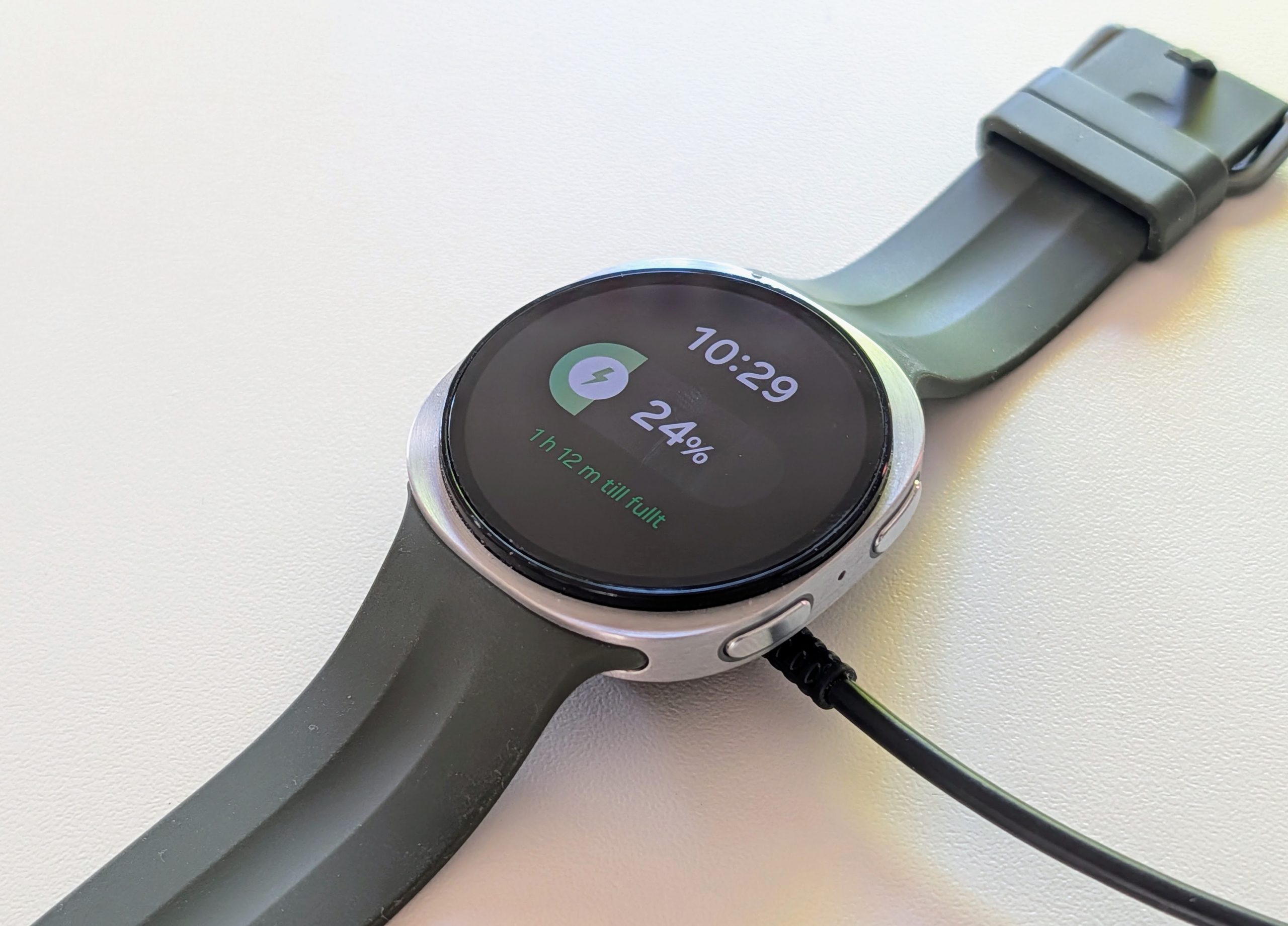
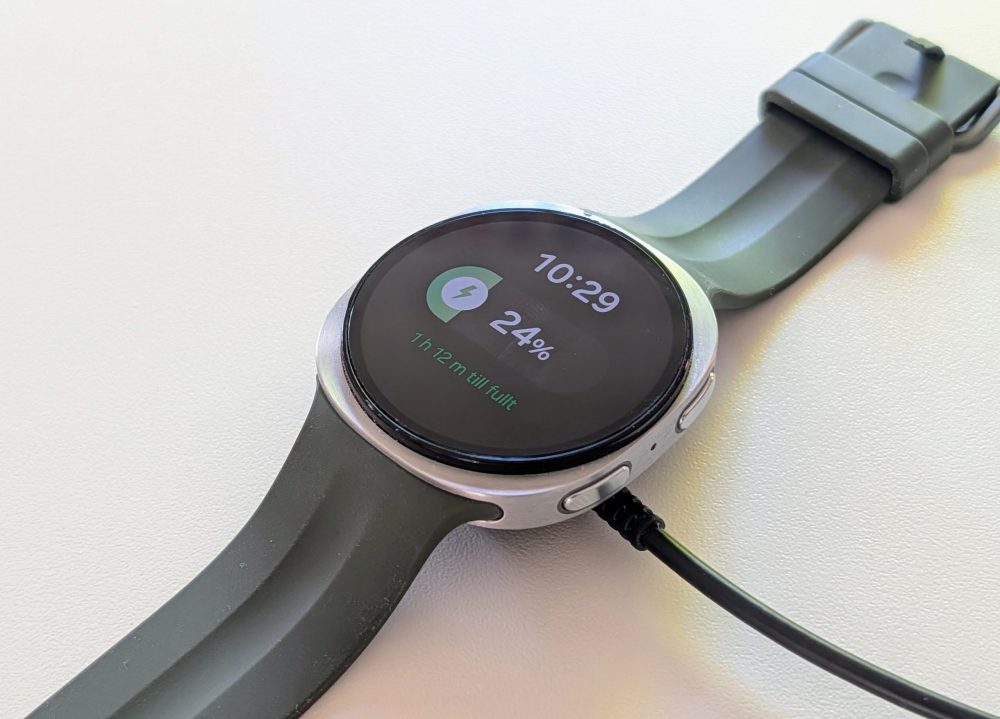
And then there’s the charging. The watch is charged with the included magnetic charging puck, and a full charge from empty takes 1 hour and 40 minutes. That is unbelievably slow for such a small battery. The OnePlus Watch 3 has 631 mAh compared to the Watch9’s 445, lasts several times longer, and is still fully charged in about half an hour.
The combination is what makes it a real problem. A watch that must be charged every day and takes nearly two hours to fill is difficult to fit into daily life. You can’t just throw it on for half an hour while you shower and eat breakfast and then go out for a workout. You have to plan. And a watch that is supposed to be worn 24/7, and is also built to track sleep, shouldn’t require planning just to be on at all.
Conclusion
Galaxy Watch9 is in many ways an excellent smartwatch. It’s stylish, it fits perfectly, the screen is absolute top-class, and performance is the best I’ve seen on a watch. The health package is enormous and completely free of subscriptions, heart rate measurement is remarkably accurate, the GPS is first-rate, and automatic workout detection is simply best-in-class. Add five OS upgrades and security updates until 2031, and you have a watch that can stay with you for a long time.
But two things significantly drag down the overall impression.
The first is the battery and charging. Daily charging in combination with such a long charging time is not acceptable in 2026, especially not when competitors manage five or six days.
The second is that four of the most interesting health functions, including ECG and sleep apnea detection, require you to own a Samsung phone. If you have a Pixel, a Xiaomi, or any other brand, you are paying full price for hardware you are not allowed to use.
And this is where it stings a little extra. When we tested the Galaxy Watch 5 in 2022, the objections were that the battery lasted one to two days, that charging took an hour and a half, that blood pressure measurement was a gimmick that required recalibration with a cuff every four weeks, and that ECG and blood pressure were locked behind a Samsung phone. Four years, four generations, and a number of processor swaps later, the exact same points remain. Charging has even become ten minutes slower, and the number of functions requiring the right phone brand has gone from two to four. In the meantime, competitors have gone from two days of battery life to five or six.
The recommended price is 4,790 SEK for the version we tested, the 44 mm with Bluetooth and WiFi. If you want to be able to leave your phone at home and still be reachable, the same watch is available with eSIM for around 5,290 SEK. That extra five hundred is actually worth considering, because that is exactly what you lose with the Bluetooth model: making and receiving calls and streaming music without a phone in your pocket. If you need that, the extra cost is small in context.
If you already have a Galaxy phone and can live with charging every day, this is the best Wear OS watch on the market. If you have another Android phone, or value being able to leave your charger at home over the weekend, there are better alternatives.
Samsung sent review units for this test. Senders of material have no editorial influence on our tests; we always write independently with you, the readers and consumers, in focus.
How we rate products at SensesReview Highlights: Q&A
Can I use every health feature if I do not own a Samsung phone?
No. The Samsung Galaxy Watch 9 requires a Samsung phone to access the Samsung Health Monitor app, locking ECG, blood pressure measurement, irregular heart rhythm notifications, and sleep apnea detection away from other Android users.
How long does the battery last and how fast does it charge?
With the Always-On Display turned on, daily charging is required. A full charge from empty using the included magnetic charging puck takes 1 hour and 40 minutes.
Does it work with an iPhone?
No. As with other Wear OS devices, it does not work with iPhone at all.
How long will the software receive support?
Samsung promises five OS upgrades and security updates until July 31, 2031.