TL;DR
Greenland 2: Migration attempts to recapture the survivalist tension of its predecessor, but this sequel might have been better left in the bunker. Following the Garrity family five years after the impact, the film is plagued by narrative inconsistencies, logic-defying world-building, and predictable tropes. While the original thrived on mystery, this follow-up falters under improbable plot armor and a lack of creative focus. Compounding these flaws, the Swedish UHD release is a major technical disappointment, lacking the HDR and Dolby Atmos features found on international versions. Is this journey worth the trek, or is the franchise running on empty? From casting head-scratchers to a lackluster 4K presentation, our review breaks down why this migration hits a dead end. Read the full analysis to see if this disaster epic belongs in your collection.
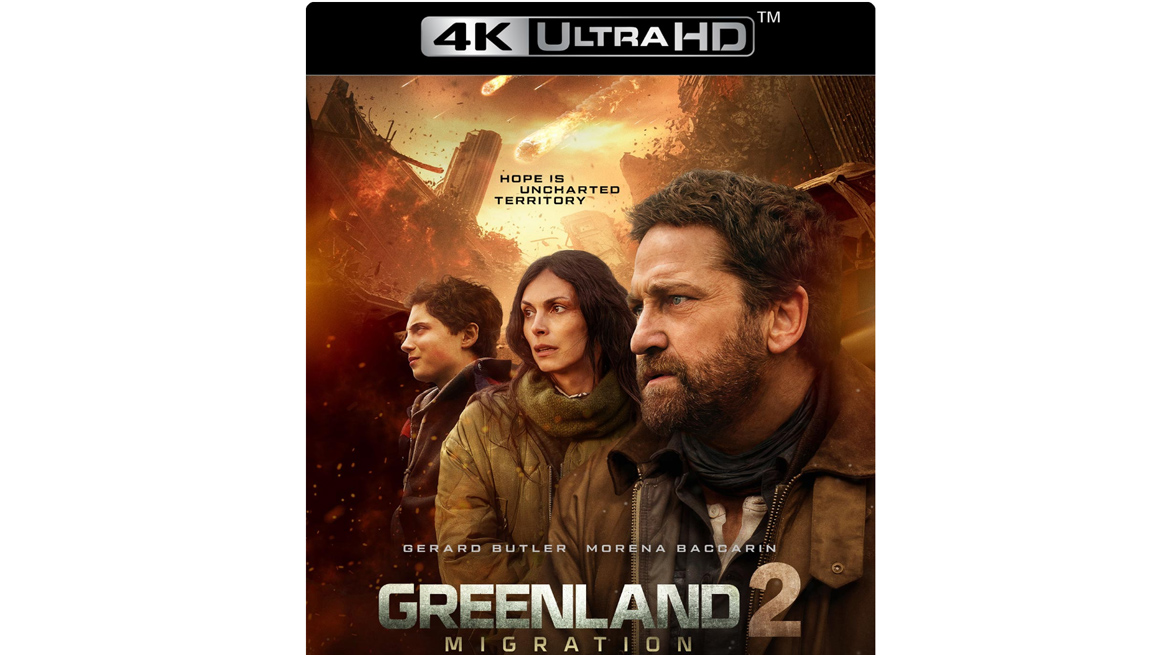
Greenland 2: Migration picks up the narrative approximately five years after a catastrophic comet impact devastated the Earth’s surface. The Garrity family, having survived the initial disaster within a Greenland bunker, have attempted to maintain a semblance of normalcy under grueling conditions. John Garrity (Gerard Butler) has fallen ill, a consequence of numerous foraging expeditions into the irradiated wasteland. When the bunker’s structural integrity finally fails, the family is forced back into the unknown. John, Allison (Morena Baccarin), and their son Nathan (Roman Griffin Davis) set their sights on a rumored impact site—now whispered to be a fertile utopia. Their journey is fraught with environmental hazards and encounters with desperate survivors whose allegiances are never certain.
A sequel of questionable necessity
Greenland 2: Migration brings to mind chaos theorist Ian Malcolm’s iconic critique: “Your scientists were so preoccupied with whether or not they could, they didn’t stop to think if they should.” In this instance, it is difficult to justify the existence of such an unnecessary follow-up.
The original Greenland premiered during the height of the pandemic and evidently achieved enough commercial success to warrant a sequel. However, much of the original film’s strength lay in its ambiguous, hopeful conclusion, allowing the audience to imagine the survivors’ future. This sequel unfortunately strips away that mystery.
Narrative inconsistencies and baffling choices
Consider the character of Nathan. Given his Type 1 diabetes, his survival after five years in a bunker would be a medical miracle bordering on the impossible. More jarring is the casting: while only five years have passed in the story, Nathan—originally played by the young Roger Dale Floyd—is now portrayed by 19-year-old Roman Griffin Davis (Jojo Rabbit). The character has effectively aged a decade in half that time. While a minor detail in isolation, it signals a broader lack of attention to detail that persists throughout the film.
Fragmented world-building
The film initially establishes that the atmosphere is saturated with radiation, citing this as the cause of John’s deteriorating health. Yet, once the family begins their trek, this environmental threat is virtually ignored. They depart in a lifeboat fueled by diesel—a fuel that typically degrades within six to twelve months—and successfully navigate 1,200 nautical miles from Greenland to England, despite the vessel having a maximum range of only 600 miles.
While total realism isn’t expected in a disaster epic, the internal logic must remain consistent to maintain immersion. Upon arriving in England, the family finds intact infrastructure, military presence, and functional vehicles fueled by apparently pristine gasoline. These narrative leaps, combined with bizarre character decisions—such as a father entrusting his teenage daughter to strangers—make it increasingly difficult to remain invested in the story.
Structural issues and predictable tropes
The script relies heavily on repetitive peril. The Garritys find themselves in constant mortal danger, only to be saved by increasingly improbable plot armor. It becomes unintentionally comical as the supporting cast is decimated while the primary family emerges from every catastrophe unscathed.
Furthermore, the pacing is entirely predictable. Every brief moment of emotional reprieve serves as a telegraphed signal for the next impending disaster. This formulaic approach drains the film of any genuine tension.
Direction and production
It is disappointing to see Ric Roman Waugh, who directed the surprisingly effective first installment, return for this sequel. The drop in quality is substantial, suggesting a production that was rushed or lacked a clear creative vision.
The UHD Edition – A technical letdown
One might hope that the UHD presentation would mitigate the film’s narrative flaws. A high-bitrate 4K transfer, a robust Dolby Atmos track, and compelling supplemental features can often redeem a mediocre cinematic experience.
Unfortunately, the Swedish release is a bare-bones affair. It lacks any special features and, most critically, omits the Dolby Atmos soundtrack found on international versions. While the import edition offers a full suite of features and superior audio, the high cost of entry is difficult to justify for a film of this caliber.
The visual presentation is equally underwhelming. The 4K image appears soft and lacks the vibrance expected of the format. There is no clear indication of HDR support on the local disc, whereas the import boasts HDR10+ and Dolby Vision. The audio is restricted to a standard 5.1 DTS track, resulting in a soundscape that feels remarkably thin.
Absent special features
While international editions are well-supplemented, the Swedish retail version offers no bonus content. Charging full price for such a stripped-down release is unacceptable. The absence of Atmos and HDR metadata even raises suspicions that this may be an upscaled Blu-ray master—an unconfirmed but plausible theory given the lackluster fidelity.
Ultimately, Greenland 2: Migration is a largely redundant sequel hampered by a weak script and uninspired direction. When paired with a technically deficient UHD release, it is impossible to recommend.
SF Studios provided review copies for this evaluation. Our reviews are conducted independently, and the providers of review material exert no editorial influence over our conclusions.
Review Highlights: Q&A
How much time has passed since the first film?
Roughly five years have passed in the story.
What is the main plot of the sequel?
The Garritys seek a rumored fertile utopia.
Do the original lead actors return?
Yes, Gerard Butler and Morena Baccarin return.
How is the 4K picture quality on this disc?
The image is soft and lacks expected vibrance.
Does the Swedish UHD include Dolby Atmos?
No, the local disc only has a 5.1 DTS track.
Are there any special features included?
No, this Swedish release has no bonus content.
Is the movie recommended for fans?
No, it is a redundant and uninspired sequel.