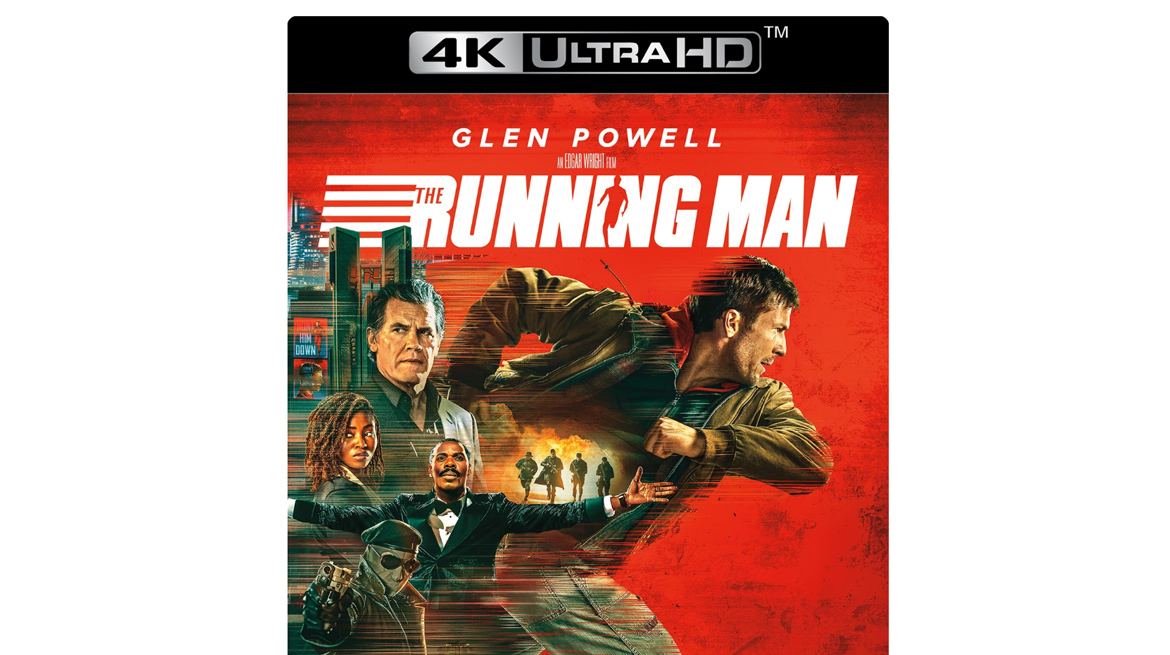

TL;DR
Edgar Wright’s The Running Man trades 1980s camp for a direct, gritty adaptation of Stephen King’s original novel. Starring Glen Powell as a desperate father in a lethal game show, this dystopian thriller promises a high-stakes race for survival. While Wright’s signature visual kineticism is dialed back and the finale struggles to capture the book's provocative ending, the film remains a polished genre piece. For tech enthusiasts, the UHD presentation is the real star, offering a flawless 4K transfer and an explosive Dolby Atmos track. Is this new vision a faithful tribute or a missed opportunity to explore modern media manipulation? Whether you’re a die-hard King fan or a home cinema buff looking for the next reference-quality disc, there is much to unpack in this technical powerhouse. Read the full review to find out if this high-stakes gauntlet is worth the watch.
The Running Man is set in a dystopian near-future where societal inequality has reached a breaking point. As the marginalized struggle for survival, broadcast television has devolved into bloodthirsty spectacles. The most notorious of these is The Running Man, a high-stakes survival game where contestants must evade specialized “hunters” authorized to use lethal force.
Ben Richards (Glen Powell) is a hardworking father desperate to fund medical treatment for his sick daughter. Seeking a way out of poverty, he attempts to enter the world of high-stakes game shows in hopes of a life-altering payout. He catches the eye of unscrupulous producer Dan Killian (Josh Brolin), who maneuvers him into participating in The Running Man. Richards soon finds himself in a deadly race for his life, discovering that in this televised gauntlet, trust is a dangerous luxury.
Not a remake — a more faithful literary adaptation
It is important to clarify that this iteration of The Running Man is not a remake of the 1987 film starring Arnold Schwarzenegger. Instead, it serves as a more direct adaptation of Stephen King’s novel, originally published under the pseudonym Richard Bachman. During that era, industry conventions limited prolific authors to one release per year, leading King to adopt an alter ego to maintain his high output.
Two of my personal favorites from King’s “Bachman” era are The Long Walk and The Running Man. While it is an interesting coincidence that both received film adaptations in the same year, they unfortunately suffer from a shared issue: a modified ending. In both cases, the original literary conclusions are significantly more impactful. More on this below.
Direction and Style
The film is directed by Edgar Wright (Shaun of the Dead), a filmmaker known for his distinct visual flair. However, it is evident that the constraints of this high-budget production may have limited his creative autonomy. His hallmark stylistic choices—dark humor, rhythmic visual storytelling, and kinetic editing—are largely absent. While the film is professionally crafted and well-acted, it lacks the signature personality typically associated with Wright’s work.
Acting Performances
The ensemble delivers generally capable performances. Glen Powell is solid in the lead, though his portrayal can occasionally feel a bit rigid. It would have been intriguing to see a frequent Wright collaborator like Simon Pegg in the role, as he arguably aligns more closely with the character’s description in the source material. Powell at times struggles to find the right balance of charm and desperation, leading to a performance that feels slightly stilted.
Josh Brolin provides his usual gravitas, though he feels somewhat underutilized in this role. On a positive note, the film is bolstered by several notable cameos from established actors who add flavor to the production. While the action sequences are well-executed, they often lack a unique creative spark, with the exception of a cleverly designed, trap-filled sequence in the final act.
The Critical Flaw: The Finale
The film’s most significant weakness is its conclusion. It is a common pitfall for productions to build a compelling narrative only to lose momentum in the final act. The novel’s ending is considerably darker and more provocative; while likely deemed incompatible with a major studio budget, its absence leaves a void.
The resulting compromise feels rushed and tonally inconsistent with the preceding acts. To make the film’s ending function, the plot relies on a series of unestablished contrivances, leaving the audience with a resolution that lacks logical weight. By adhering to the book’s structure for too long without committing to its payoff, the filmmakers ultimately boxed themselves into a creative corner.
Unrealized Potential
Beyond the narrative issues, there is a sense of missed opportunity regarding the film’s themes. Even the 1987 original explored media manipulation through “deepfake” style editing—a concept that is more relevant than ever in today’s AI-saturated landscape. A modern vision of The Running Man should have delved deeper into the implications of synthetic media and systemic surveillance rather than treating the premise as a straightforward thriller.
Ultimately, it feels as though the creative team was working within narrow parameters, preventing a truly bold or innovative vision from emerging.
The UHD Edition
Technically, however, the UHD edition is outstanding. The 2.39:1 transfer at 2160p (4K), featuring both Dolby Vision and HDR10, is exceptionally sharp and vibrant. Black levels are deep and stable, while the garish aesthetic of the futuristic game shows is rendered with superb color accuracy and contrast. Low-light scenes are impressively balanced, and high-dynamic-range highlights provide excellent pop.
The Dolby Atmos audio track is equally impressive. The mix is well-defined, with crystal-clear dialogue and authoritative low-end response during action sequences. The surround and height channels are effectively utilized, particularly during the aerial sequences and the high-velocity car chases.
The supplement package is surprisingly robust. It includes documentaries that provide genuine insight rather than standard promotional fluff, and the fictional “in-universe” TV shows are included in their entirety. Additionally, a commentary track featuring Edgar Wright, Glen Powell, and screenwriter Michael Bacall provides excellent context for enthusiasts.
Conclusion and Verdict
How does this new vision of The Running Man hold up? While viewers unfamiliar with the source material will find it a polished and entertaining thriller, it occasionally misses the mark as a definitive adaptation. However, the sheer quality of the UHD presentation significantly enhances the viewing experience.
I recommend The Running Man as a solid genre entry, provided you don’t go in expecting a remake of the 1987 classic. The two versions share little in common, though the filmmakers have included several clever nods to the original for eagle-eyed fans.
SF Studios provided a review copy for this evaluation. Our editorial content remains independent, focusing solely on providing objective analysis for our readers and consumers.
Review Highlights: Q&A
Is this film a remake of the 1987 Arnold Schwarzenegger movie?
No, it is a more direct adaptation of the original Stephen King novel.
Who stars as the main character, Ben Richards?
Glen Powell plays the lead, a father desperate to save his sick daughter.
How does the visual quality of the 4K UHD edition look?
The transfer is exceptionally sharp with vibrant colors and deep blacks.
What is considered the most significant flaw of the movie?
The finale feels rushed and inconsistent with the rest of the narrative.
Does the film feature Edgar Wright’s signature directing style?
His usual dark humor and kinetic editing are unfortunately absent here.
What kind of bonus material is included on the disc?
It features documentaries, in-universe TV shows, and a commentary track.
Does the movie use the same ending as the Stephen King book?
No, the film uses a modified ending that is less impactful than the book.
What are the audio specifications for the home release?
The disc includes a Dolby Atmos track with clear dialogue and deep bass.