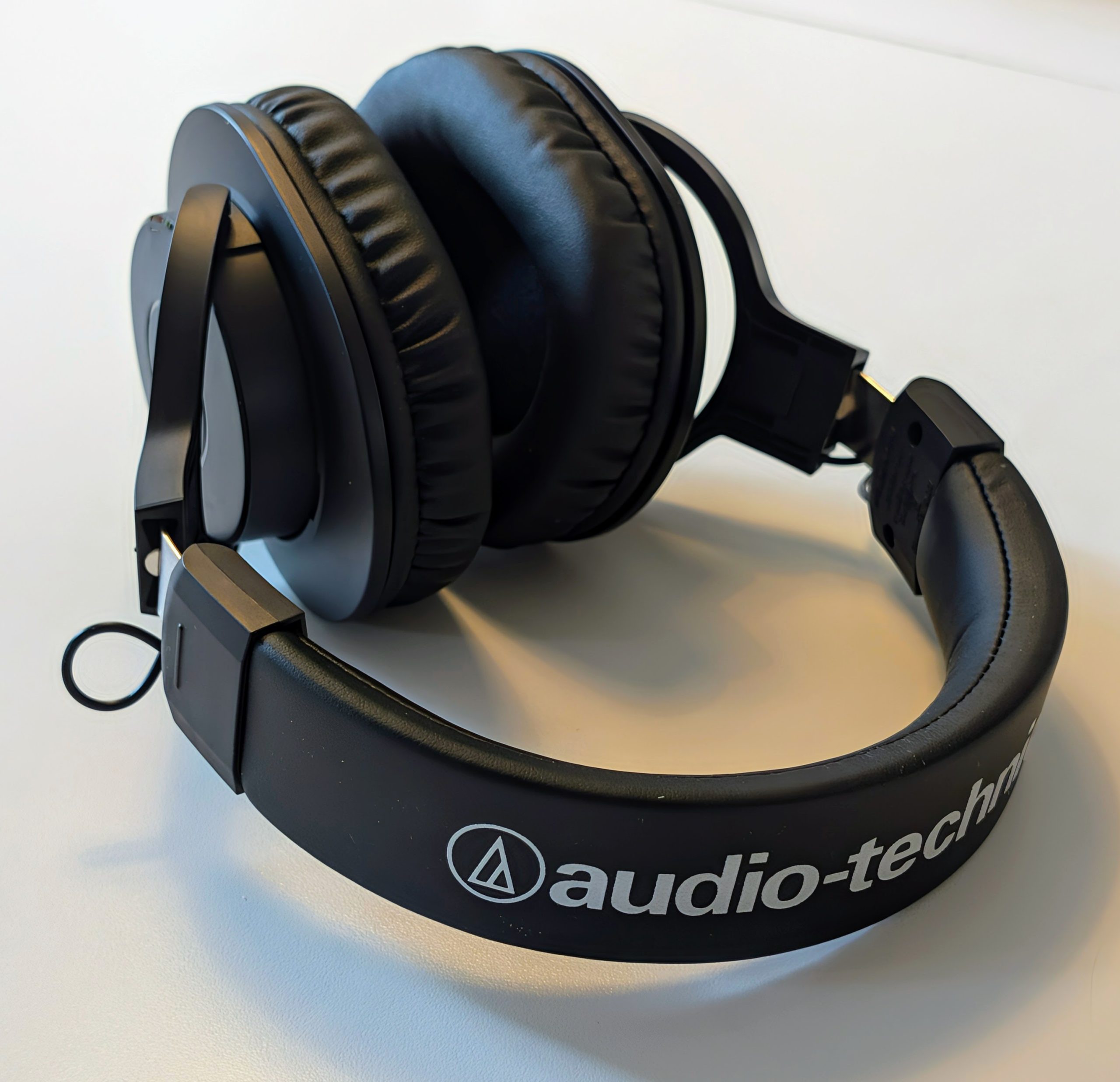

TL;DR
The Audio-Technica ATH-M20xBT are wireless studio monitor headphones delivering clean, balanced sound and up to 60 hours of battery life. However, they feel cheap and plasticky, lack active noise cancellation, have no app or equalizer, and do not fold for travel. Priced at 990 kr, they suit listeners wanting straightforward, faithful audio for home or work without extra features.
How much do a pair of headphones really need to be capable of in 2026? No app, no equalizer, no noise cancellation, and no LDAC. Audio-Technica ATH-M20xBT is instead based on the ATH-M20x, the entry-level model in Audio-Technica’s M-series. The series is nearly legendary among monitor headphones—that is, headphones designed to reproduce sound exactly as it was recorded without embellishing anything—and the wired models have for many years been an obvious choice in studios and home studios. Here, the M20x has been given built-in Bluetooth, a battery, and a microphone. It promises up to 60 hours of battery life, multipoint connectivity, and the option to use a cable. It’s no more complicated than that, yet the recommended price lands at 990 kronor.
It sounds almost provocatively simple. Can the sound alone justify the price? Let’s find out!
Design and comfort
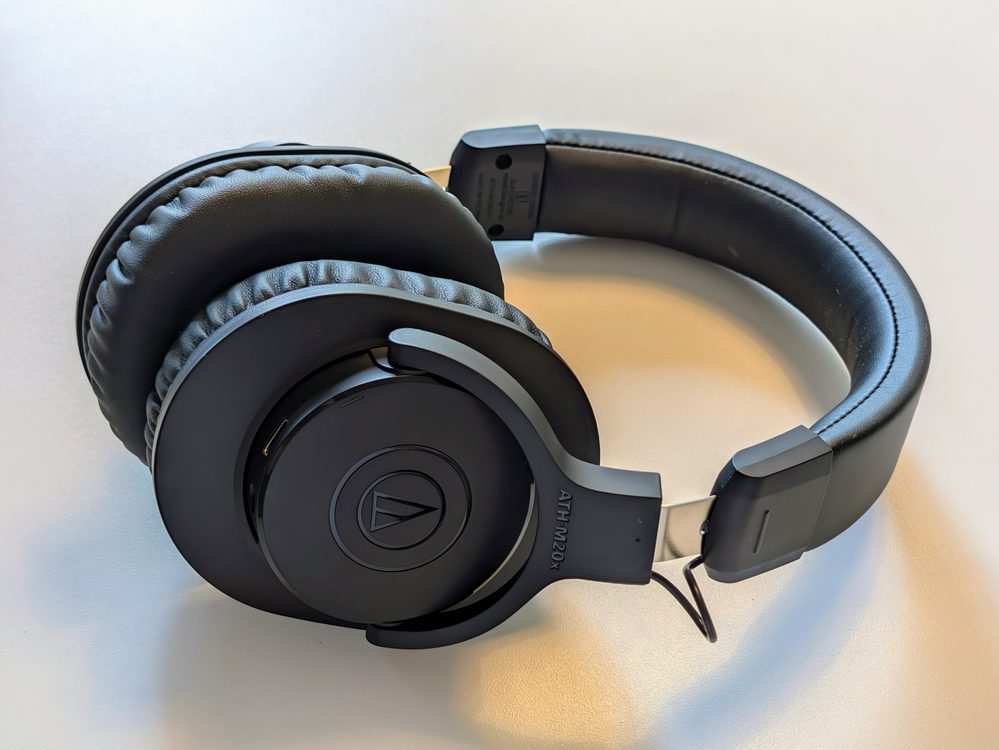
Let’s start with the positives. The ATH-M20xBT is a pair of stylish headphones. They have the same minimalist studio look as the rest of the M-series, and it’s a design that holds up.
But that only applies from a distance. Holding them in your hand, there’s no hiding it. The headphones are plasticky and they feel cheap. It’s hard to escape the fact that they feel cheaper than their price tag suggests. Not everything is plastic, however. The rails in the headband, where you adjust the size, are made of metal, and they feel stable. But that’s where the metal ends; the rest is plastic.
It’s also unclear which cup is left and which is right, and you almost have to guess every time you put them on. The easiest way is to feel for the buttons, which are located on the left ear cup.
Furthermore, they are impractical to take with you. The cups do not fold or swivel flat, so they take up a lot of space in a bag, and when worn around the neck, they press against the throat. Visible cables run between the cups and the headband, a detail one would rather avoid on headphones meant to be carried in a bag. No carrying case is included either. In the box, there is a USB-C cable for charging and a 1.2-meter long cable with a 3.5 mm plug.
Because the headphones are so plasticky, they are also very light, around 216 grams, and they don’t press hard against the head. This makes them comfortable to wear, and you almost forget you have them on. The ear cushions, however, are shallow and quite stiff, and after a couple of hours, you start to feel them. The seal around the ears isn’t particularly tight either, which is noticeable in the isolation. Outside noise gets in, and these are not headphones for the bus or the plane.
No apps here
All control is handled by three physical buttons on the left ear cup. You adjust the volume, pause, change tracks, and answer the phone. It works well, and the buttons have clear pressure points. There is no wear sensor, so the music doesn’t pause when you take the headphones off.
And that’s the end of the features. There is no app for the ATH-M20xBT. Audio-Technica has its own app, Connect, but this specific model is not supported. This means no equalizer, no sound profiles, and no firmware updates via your phone. What you hear out of the box is what you get. That sounds like a drawback, and on paper, it is, but it becomes more interesting once you actually start listening.
Sound quality

In each ear cup sits a 40 mm driver, and this is where the ATH-M20xBT shows why it exists. Because here, everything changes. They sound very good.
It’s almost hard to believe that the sound is coming from the same plasticky headphones that felt so cheap when unboxing them.
The soundstage is clean, balanced, and straightforward. No cranked-up bass that overrides everything else, no sharp treble meant to make the sound seem detailed. Voices sound natural, and instruments are allowed their space without being crowded. The bass has weight and is tight, even if the deepest rumble is somewhat recessed compared to more crowd-pleasing headphones.
I put on Something I Can Never Have by Nine Inch Nails, a song I’ve listened to a million times. And in the middle of the song, I hear birdsong. Birdsong that I have never noticed before, on any of the headphones or speakers I’ve used to listen to that song. Now I hear the birdsong regardless of what I test with, but this was the first time I reacted to it. It’s a rather telling example of what these headphones do. They don’t add anything, they don’t take anything away; they simply play back what is in the recording.
The stereo image is clear and well-separated, and the soundstage feels relatively wide for a pair of closed-back headphones. Here, the heritage from the M-series is clearly evident. Monitor headphones are made so that you can hear what is actually happening in a mix, for better or worse, and it is precisely this quality that has carried over to the wireless version. It’s no coincidence that the birdsong suddenly appeared.
On the other hand, I would have liked to be able to play them louder. The maximum volume is stingy, and when a favorite song comes on and you want to crank it up properly, it stops sooner than you’d like. For most people, it’s sufficient for everyday use, but those who like to listen loud will miss those extra steps.
The lack of an equalizer actually feels less important than expected. The sound is so right from the start that you don’t find yourself longing to adjust it.
With the cable connected, the headphones also work passively—that is, when the battery is dead or the headphones are turned off. The buttons do not work then, but it’s a good backup, and for those who want to plug the headphones into an audio interface or an amplifier, it’s a significant plus.
Connectivity and codecs
The Bluetooth section is as simple as the rest. The headphones run Bluetooth 5.0 and only support SBC and AAC. There is no LDAC, aptX, or similar. This is a clear limitation for Android users accustomed to high-resolution wireless audio, and given how good the headphones sound, it would have been interesting to hear them with a better codec. If you want the maximum output, you have to use the cable.
Multipoint is available, however, so the headphones can be connected to, for example, a mobile phone and a computer simultaneously, and switching between them is smooth. The connection has been stable during the testing period.
There is also a low-latency mode activated by three presses on the center button. It noticeably reduces lag when watching movies or playing games on a mobile device. It doesn’t disappear completely, but the lip-sync works well enough for movies and series.
Calls
The microphone is located in the left ear cup and does its job, but nothing more. In quiet environments, you are heard clearly, although your voice sounds a bit muffled. As soon as it gets noisier around you, the background noise bleeds through. It’s sufficient for a quick call from home, but for those who sit in many meetings, there are better alternatives.
Battery and charging
Battery life is the headphones’ other great strength. Audio-Technica specifies up to 60 hours, and that seems accurate. You can listen for several hours a day for over a week without thinking about the charger. The fact that there is no power-hungry noise cancellation certainly helps.
Charging takes place via USB-C and a full charge takes about four hours, which is slow. Ten minutes of charging is supposed to provide up to three hours of listening, and that holds up quite well.
Conclusion
The Audio-Technica ATH-M20xBT is an unusual pair of headphones for 2026. They are stylish and the plastic build makes them light and comfortable, but that’s about where it ends. They are plasticky, they feel cheap, and they lack essentially everything that competitors fight over. No app, no EQ, no noise cancellation, no LDAC, and no wear sensor. The ear cushions are shallow, the isolation is weak, and they are impractical to carry because they don’t fold. And despite this, they cost a fair amount.
At the same time, there is something refreshing about it. In a time when almost all headphones compete for the most features, with noise cancellation, apps, and plenty of odd functions, Audio-Technica comes out with a pair of headphones that has zero. no case, they don’t fold, no app, and no features to speak of. Plasticky as heck. But the sound is exactly where it should be, and it simply becomes fun to listen to music.
The heritage from the M-series is unmistakable. They sound extremely good for the price—clean, balanced, and detailed. They might not be the best-sounding headphones we’ve ever tested, and they don’t have the heaviest bass. But they make you want to keep listening, song after song, and that is worth a lot. Add to that a battery life that lasts over a week and the ability to use a cable even with a dead battery, and you have a pair of headphones that do the most important things really well.
Then there’s the price. The recommended price is 990 kronor. For that money, you get nothing beyond the sound and the battery. If you want noise cancellation, an app, and LDAC in the same price range, the EarFun Wave Pro X is a significantly more complete package. But for those who primarily listen at home or at work and just want really good sound without the hassle, it is money well spent.
Audio-Technica provided review units for this test. Material providers have no editorial influence on our tests; we always write independently with you, the readers and consumers, in focus.
How we rate products at SensesReview Highlights: Q&A
How good is the sound quality on these headphones?
The Audio-Technica ATH-M20xBT delivers clean, balanced, and detailed audio via 40 mm drivers, reproducing recordings accurately without overemphasized bass or sharp treble.
How long does the battery last and how fast does it charge?
Battery life lasts up to 60 hours. A full charge takes roughly four hours over USB-C, while a ten-minute quick charge yields up to three hours of playback.
Can you use the headphones with a cable when the battery dies?
Yes, plugging in the included 1.2-meter 3.5 mm cable allows passive playback even when the battery is completely drained or the power is turned off.
Are these headphones good for commuting or travel?
No, the ear cups do not fold or swivel flat, isolation is weak, there is no active noise cancellation, and no carrying case is included in the box.
Which Bluetooth codecs and connectivity features are supported?
They feature Bluetooth 5.0 with SBC and AAC codec support, alongside multipoint pairing for two devices and an optional low-latency mode for video.