
TL;DR
MyDear.exe is an indie desktop narrative game where players search through computer folders to uncover a couple's life story. It succeeds with cozy retro nostalgia and pleasant mini-games, but falls short due to messy folder navigation and frustrating backtracking lacking map tracking. It suits players seeking a brief, nostalgic two-hour narrative experience, but those wanting structured exploration should skip it.
There are a few recurring clichés often used when writing about indie games. Others like to describe them with these terms—and I will certainly do the same during upcoming reviews of such games here on the site. This primarily concerns how indie games often push the boundaries in a way we perhaps more rarely see among major game releases. These risks can involve everything from the gameplay concept to the visuals. As mentioned, you have surely heard this before. You will guaranteed read it again.
And all of this is true for MyDear.exe. It is the debut game from the French studio Falling Leaves (developed in collaboration with ClemiSoft). They describe their vision like this: “We make small games to enjoy during a rainy afternoon. Snuggled in a blanket with a hot cocoa.”
This is also absolutely the feeling one gets from MyDear.exe so the description is definitely fitting. I also read how it was described as a “Foldervania”—which, of course, is a fun little play on words regarding the popular Metroidvania style of games. In short, this is about experiencing a life story between the characters Ellie and Lucien. The former logs onto her computer (where the entire game takes place) where Lucien has created a small game for her that summarizes their life together.
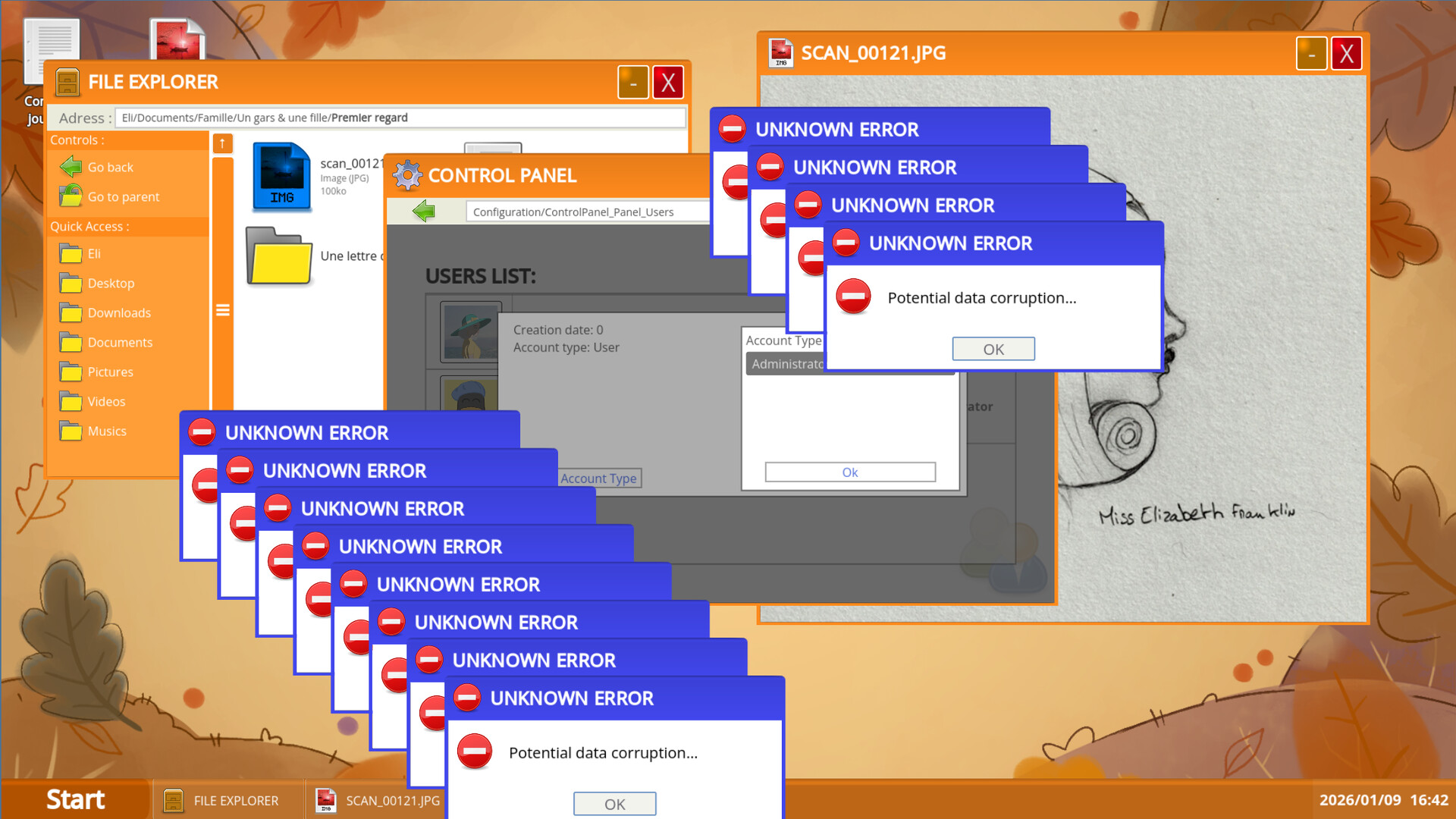
Everything thus takes place on the desktop; among folders and their files that you are to search through. There are text documents, images, programs, and mini-games that constitute the actual gameplay experience alongside the story you are taking part in. The “Foldervania” concept lies in the fact that these documents contain passwords that allow you to open other files, there are images that must be pieced together, and there are mini-games that must be completed. That is roughly what it is all about—clicking your way forward to find the right things so that you can… click your way further.
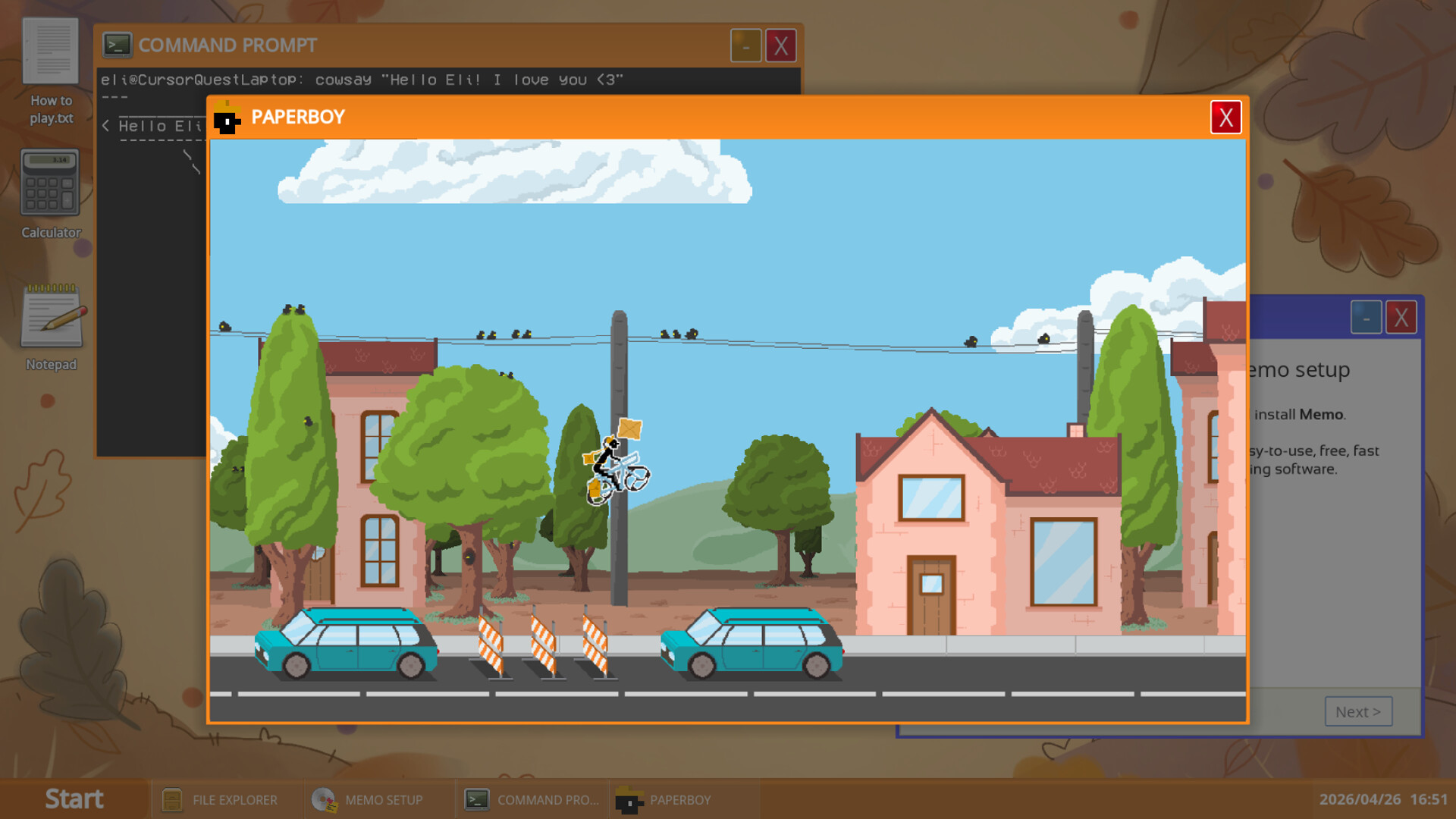
The various mini-games that exist then serve as a break from the detective work of searching for passwords. These consist of a game where you jump over obstacles on a bicycle, a game where you, as the family cat, fight birds, a dog, and a boy in a propeller cap, as well as a Pokemon-inspired game where you, as the newly acquired dog, must make the right choices.
Everything in this little game is very stripped-back and simple, and the various levels require at most a try or two to complete. When you succeed, a new folder opens so you can proceed. Most often, however, a password is required to gain access to new folders. These passwords are along the lines of “What year did we meet” or something similar, so it is important that you have read all documents carefully. The game also has a function with Post-it notes that appear on the side of the screen so you can write down all the clues and other things you come across. In other words, you have usually already written down the answer by the time you encounter the prompt. Or hopefully so—because otherwise, there will be a fair amount of backtracking, which I find is perhaps the game’s greatest weakness.
Because where the Metroidvania/Foldervania concept both intersects and clashes a bit here is in how it works as a whole. Where we are used to quickly reaching a place on the map in the former type of game where we then need a certain item to proceed—only to then explore what we can—it works essentially the same way here. Quite quickly, we encounter a folder or something that needs to be “unlocked” with a password. The big problem arises in that we don’t exactly have a map, or any way to sort or clearly distinguish between “environments/folders” to explore, but instead have to go back, look around, read, and try to find the password. It simply becomes a bit messy and without any direct sense of offering more distinct exploration.
Since the map itself here is just a mess of folders that open, close, go back, check again—without the game telling you what is finished or having any direct way to show what has been searched—you quickly end up just sitting there clicking your way through. A password might be “What did it say on that note?” Hopefully, as mentioned, you have been diligent and written down everything of value on one of your Post-its, but it still happens quite often that you have to search around again. Especially when you later install a program that allows certain files to be read.
Because where the previous things could not be opened, you now have to click back to them. It becomes a type of “backtracking” that, in a pure Metroidvania, can of course also be frustrating at times. But where those games have environments, enemies, platforming, and other things that offer entertainment, all such things disappear here for obvious reasons. I don’t really know how one could get around that, though. But there is a structure in how folders and files are laid out that contributes a bit to this frustration. You don’t really know when you are completely finished with a part of something, and the game doesn’t really tell you where you are. The story is certainly linear in how the two characters meet, fall in love, and create a life together—all in the form of text boxes like a visual novel. But the storytelling becomes a bit messy and loses its impact when it becomes choppy.
Anyone who has rooted around in folders on an unorganized computer—their own or perhaps, heaven forbid, someone else’s—knows how messy it can actually get. I think MyDear.exe would have benefited a bit from things like images or mini-games being more structured so you always knew where to return.
I like the idea as a whole, however. Sitting at the desktop of the little retro PC feels nostalgic and cozy. And when the classic Minesweeper appears as a mini-game, it’s hard not to smile for all of us who were around back in the day. The other mini-games are also quite pleasant, and there is something genuinely interesting here about building a life story around the concept of searching for memories and stories among folders and files. It is not entirely successful in terms of the interface—but the short playtime of just over two hours also means that it is over before any direct frustration has time to truly set in. Ultimately, however, it remains a more interesting concept than it is a truly fun execution.
Falling Leaves Studios sent a review code for this test. Senders of material have no editorial influence on our tests
Review Highlights: Q&A
What is the gameplay loop in MyDear.exe?
MyDear.exe takes place entirely on a retro computer desktop. Progression involves opening files, piecing together images, completing mini-games, and locating passwords to unlock new folders.
What mini-games are included?
Mini-games include jumping over obstacles on a bicycle, fighting birds and a dog as a cat, a Pokémon-inspired pet choice game, and classic Minesweeper.
How long is the game?
The game has a short playtime of just over two hours.
What makes navigation difficult?
There is no map or system to mark finished folders. When passwords or new programs are acquired, locating unread files requires messy clicking through multiple directories.