
TL;DR
The Samsung Galaxy Z Fold8 is a wide-format foldable phone costing 23,990 kr. It excels with its usable 5.5-inch outer display, bright 3,000-nit screens, and class-leading multitasking software. However, it lacks a dedicated telephoto camera, throttles and runs hot under sustained pressure, and wobbles on flat surfaces. It suits buyers seeking a foldable that works naturally as a regular phone when closed.
What is actually the point of a foldable phone if it is a compromise as soon as you fold it shut? This has been the fundamental problem with foldable phones since the beginning: a narrow outer display that you only use to check notifications, and a large inner display that you have to unfold as soon as you want to do something for real. Samsung Galaxy Z Fold8 changes the format entirely. It is wide and short, much like a passport, with a 5.5-inch outer display in 10:16 and a 7.6-inch inner display in 4:3. Added to that are the Snapdragon 8 Elite Gen 5 for Galaxy, a 4,800 mAh battery, 45 W charging, and seven years of updates.
But does the wide format really solve the problem, or is Samsung simply swapping one compromise for another? Let’s find out!
Design and Build Quality
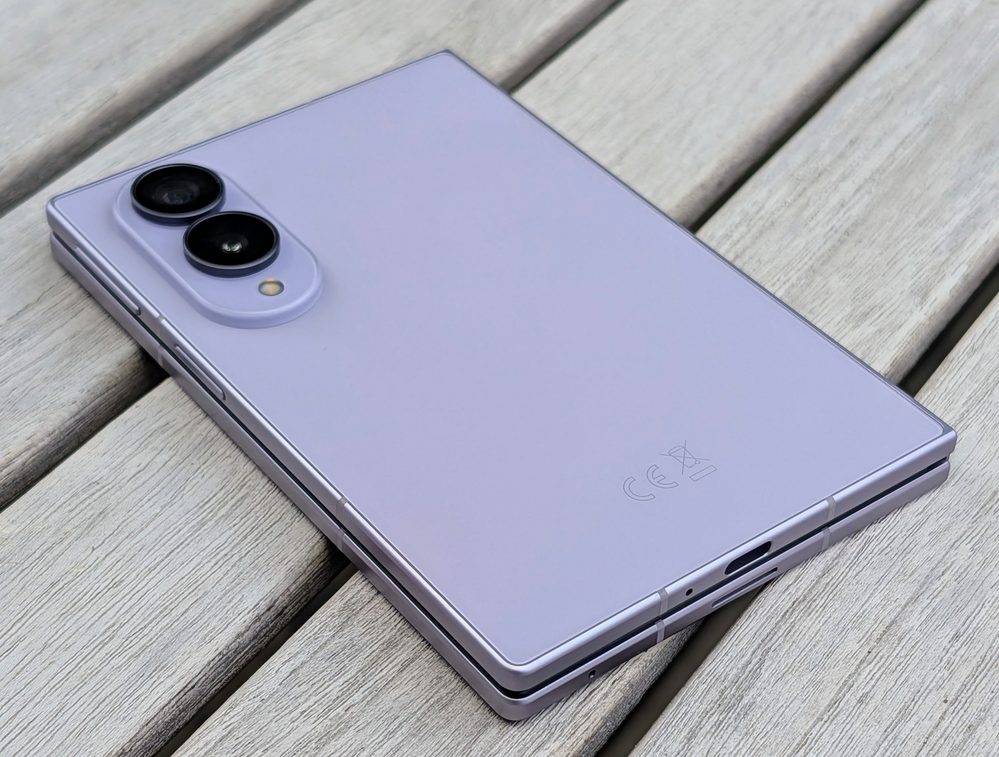
201 grams and 4.5 millimeters thick when unfolded. Folded, it measures 81.9 x 123.9 x 9.7 millimeters. It is a format that makes all the difference, and it is easily the most enjoyable phone I have held in my hand for a long time.
The frame is made of Armor Aluminum, the outer display is protected by Gorilla Glass Ceramic 3, and the back by Victus 2. Under the foldable panel sits Flex Titanium, a titanium layer designed to keep the stack rigid despite its thinness. It truly feels like quality, through and through. The hinge opens with a firm click and lays completely flat without a V-shape. However, it is either open or closed. There is no longer a halfway position, so the phone cannot be folded to 90 degrees to stand on a table for video calls or watching movies. This was possible on the predecessor and is possible on most other foldables. The IP rating is “only” IP48, meaning it is resistant to particles over 1 millimeter and submersible in 1.5 meters of water for 30 minutes. This is still a step below the IP68 rating found on standard mobiles, and fine-grained dust is not this phone’s friend.
Two things are annoying. The fingerprint reader is located in the power button on the side, and because the phone is so extremely thin, the reader’s surface area is very narrow. It works, but it is far from the best we have tested, and it doesn’t always register on the first attempt. And then there is the classic Samsung problem: the camera island protrudes in one corner, so the phone wobbles significantly when it’s lying on a table and you’re using it.
The Displays
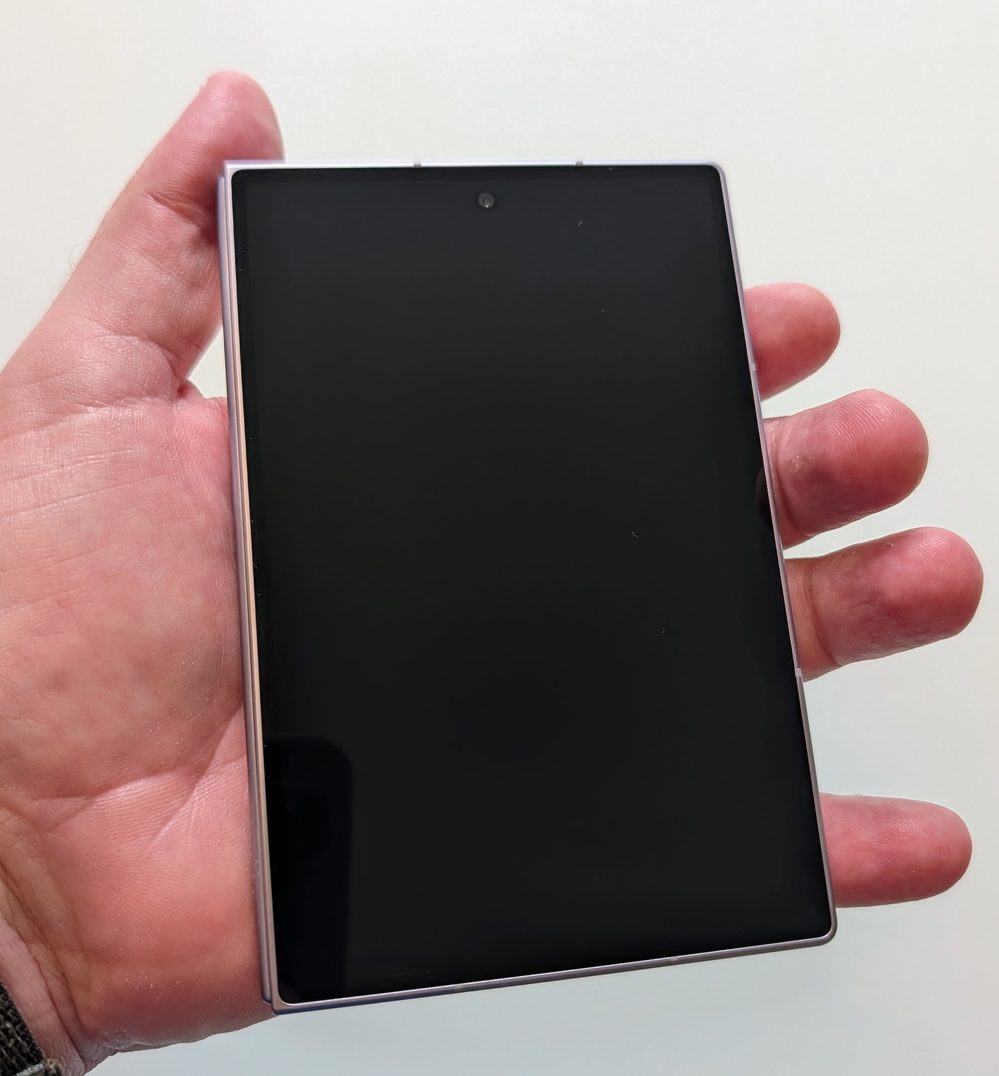
Samsung delivers here. Both panels are LTPO AMOLED with 120 Hz and 3,000 nits peak, and they are extremely good. The outer display is 5.5 inches with 1,248 x 1,972 pixels, while the inner display is 7.6 inches with 1,828 x 2,448 pixels, featuring HDR10+ and an anti-reflective coating that is truly noticeable outdoors.
But it’s not the specs that matter; it’s the format. The outer display is so wide that it functions like a completely normal phone. I can type with two thumbs, scroll, reply to emails, and navigate without missing anything. This does something unexpected to how you use the phone: after about a week, I found myself barely unfolding the large screen at all. On a standard, narrow foldable, it’s the opposite—you unfold it as soon as you need to do more than read a notification. This is the single biggest reason why I like this phone.
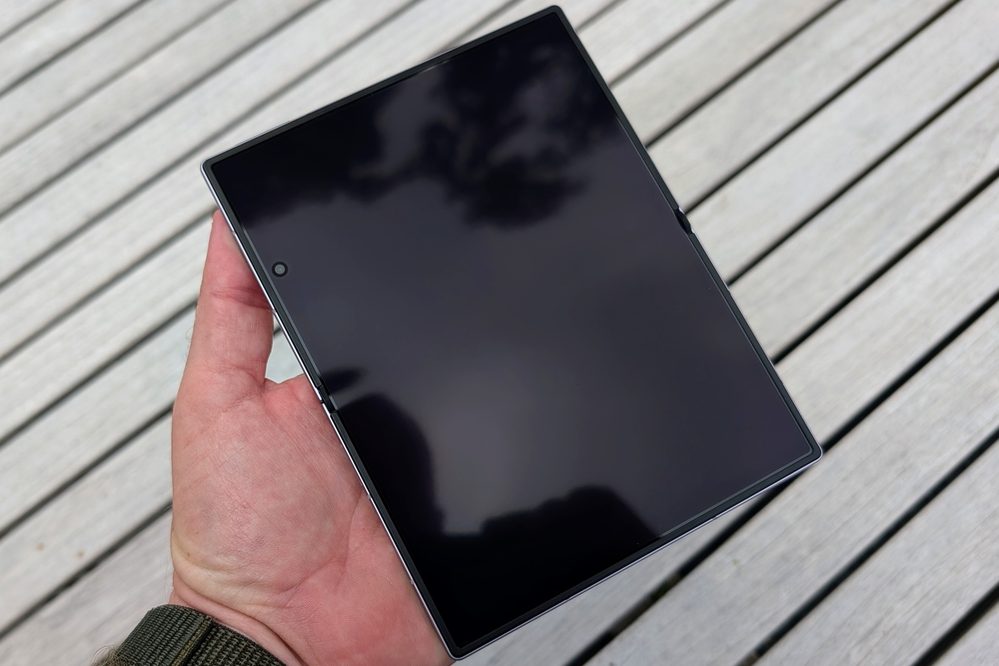
If you do unfold it, you get a small tablet in 4:3, and that format is fantastically rewarding for certain things. Movies, e-books, comic books, retro games, and long articles look great. The crease is not distracting, and during the weeks I’ve been testing it, I haven’t noticed any degradation at all, neither visually nor when running my finger over it.
What I do get hung up on every time, however, is the hole-punch camera in the inner display. It is large, strangely placed, and more distracting than you might think in full-screen video and while reading. The image quality is better than an under-display camera like early Fold models had, but I would have preferred an unbroken surface.
Then we have the apps. Not all are ready for the wide format. Some don’t fill the entire screen, others behave strangely during rotation, and you have to experiment a bit with holding the phone in 4:3 or 3:4 to find the orientation the app actually likes. It improves over time, but it’s not fully resolved today.
Performance and Heat
Snapdragon 8 Elite Gen 5 for Galaxy, 12 GB RAM in the 256 and 512 GB models, and 16 GB in the 1 TB variant. In everyday use, there is nothing to complain about. Apps start instantly, multi-window multitasking is smooth, and the camera is fast.
Under pressure, the picture is different. During longer benchmark runs, it loses significant performance, and I would expect the same during very long gaming sessions with heavy titles. There is simply no room for proper cooling in a 4.5-millimeter thin phone.
It also gets hot. Really hot. If you run at high or maximum brightness, play games, or film in 4K for an extended period, you can clearly feel it in your hand—especially when folded, where all the heat is concentrated in one half. Unfolded, it dissipates better.
Software and AI
The phone runs One UI 9 on top of Android 17. One UI is not just a skin; Samsung heavily rebuilds and adds on top of Android, and on a foldable, that is exactly what makes the difference. Split View in two and three parts, apps you can save in pairs, drag and drop between windows. No manufacturer comes close to Samsung when it comes to multitasking.
As usual, Samsung has plenty of AI features. For example: Photo Assist lets me edit images with a prompt box, such as removing a cluttered object or moving a subject; My FanCam automatically follows a subject in video; and Audio Eraser removes wind noise, traffic, and chatter from a clip afterward. Most of it supports Swedish, but not everything.
Quick Share now also works with Apple devices, and Switch to Samsung can wirelessly transfer contacts, photos, messages, and home screen layouts from an iPhone.
Samsung DeX turns the phone into something other than a phone. Connected to a monitor via USB-C, it provides a desktop mode with up to four workspaces and five app windows in each. If you don’t have a mouse and keyboard with you, the inner display can be used as a large trackpad with a virtual keyboard. It’s more than enough for replying to emails and editing documents in a hotel room where the TV is the only screen.
The update policy is, as usual, Samsung’s strongest card. Up to seven major Android upgrades and seven years of security updates.
Battery and Charging
4,800 mAh, and it is the first silicon-carbon type battery in a Fold. Samsung specifies up to 26 hours of video playback.
Screen-on time lands between five and seven hours with typical mixed use, and that range actually says more than the figure itself. It depends almost entirely on how often you unfold the large screen. If you mostly use the outer display, the phone lasts significantly longer than if you have it unfolded all day. On a normal day, you’ll get through without a charger, and on a light day using the outer display, you’ll get well into the next day.
Charging is 45 W via cable with Super Fast Charging 2.0, which is the first time a Fold from Samsung has gone above 25 W. Samsung claims 67 percent in half an hour, and I measured 64 percent in 30 minutes and about an hour and fifteen minutes for a full charge. Wirelessly, it charges at 20 W according to Qi 2.2, but the phone lacks built-in magnets, so full power requires a case with a magnetic ring. Reverse wireless charging at 4.5 W is available to top up a pair of headphones.
Cameras
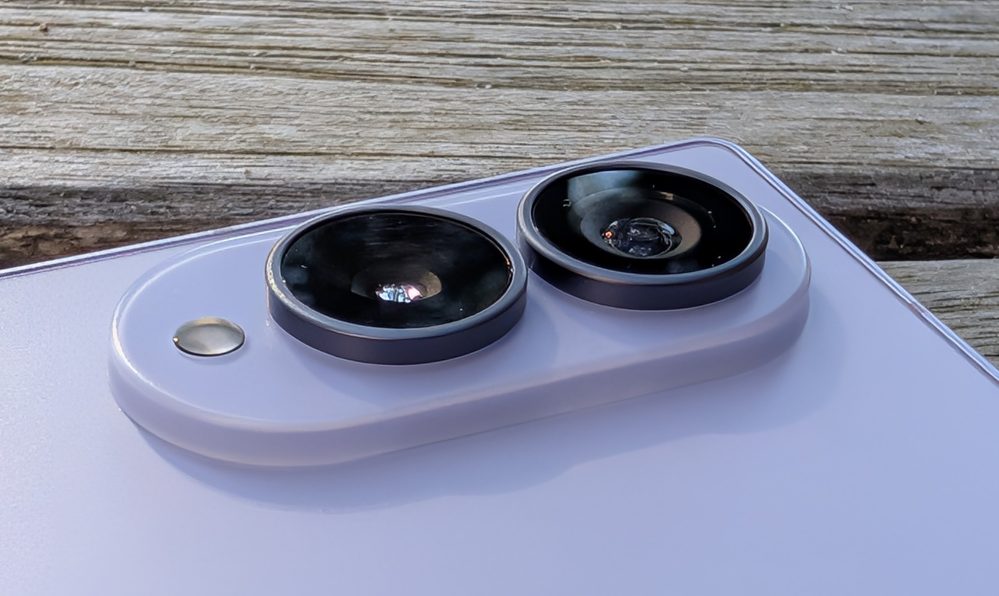
Dual 50 MP: a main camera at f/1.8 with optical stabilization and an ultrawide at f/1.9 with autofocus. 2x zoom is handled in-sensor, with digital zoom up to 10x. The selfie cameras are 10 MP each, one in the outer display and one in the inner display. Video goes up to 8K at 30 frames per second and 4K at 60, with LOG and support for LUTs.
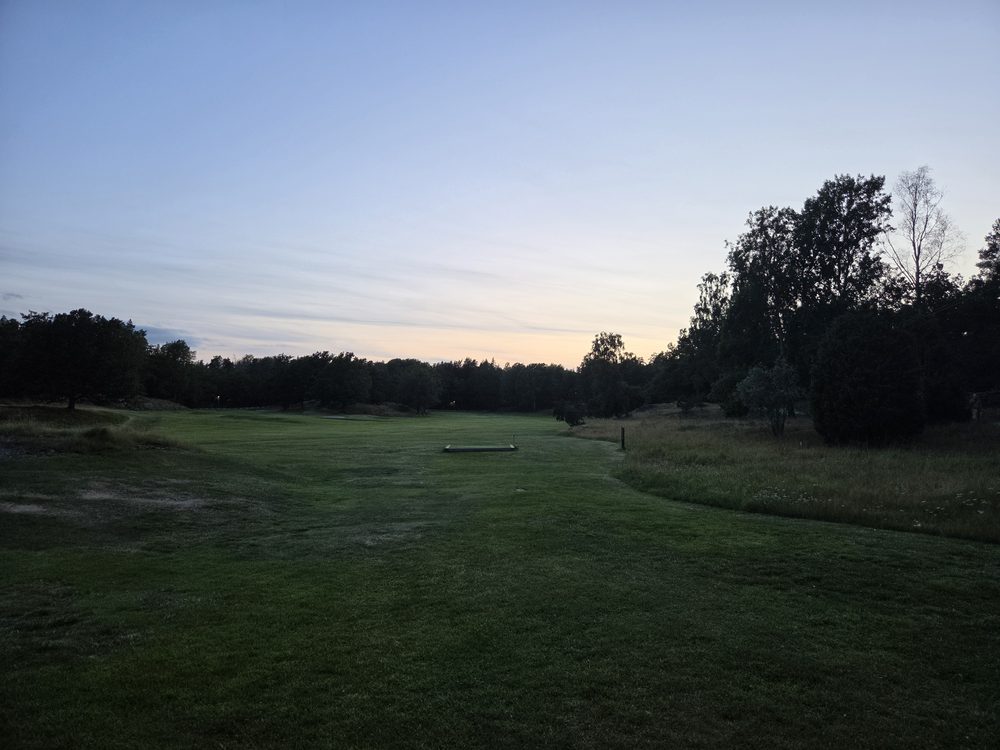
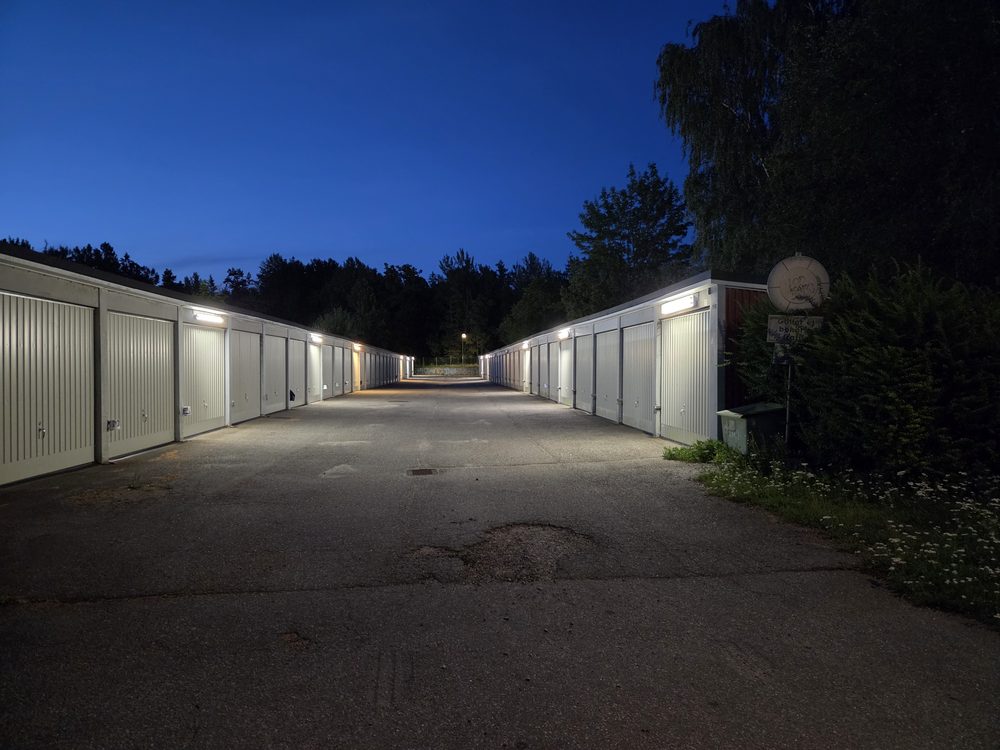
In daylight, it takes good pictures. The colors are typical Samsung, the ultrawide is strong and can also be used for macro thanks to the autofocus. But there is no telephoto lens at all, and it shows. Once you zoom past 2x, detail drops quickly, and 10x is mostly a last resort. In low light, the main camera is not flagship-class. The camera is simply OK, and OK is not enough when the phone costs what it does. If you want Samsung’s best camera, the Galaxy S26 Ultra is still the way to go, and if you want a foldable with better zoom, you’ll have to look at the Google Pixel 10 Pro Fold.
The fun part is instead what the format makes possible. You can unfold the phone, use the outer screen as a viewfinder, and take self-portraits with the 50 MP main camera instead of the selfie camera, which yields significantly better results. You can film with the front and back cameras simultaneously with Dual Recording.
One annoying thing: you constantly smudge the outer display and the cameras when the phone is unfolded, as your fingers end up right there. If you don’t wipe the lenses, the pictures get blurry—an extra step you simply don’t have with a regular phone.
Some sample images photographed with the Samsung Galaxy Fold 8:


Audio and Connectivity
The stereo speakers are both located on the same half when the phone is unfolded, which results in poor stereo separation in landscape mode. The sound quality is acceptable for some YouTube and a podcast, but it doesn’t get very loud and the audio lacks bass.
Otherwise, most things are present: 5G, Wi-Fi 7, Bluetooth 6.0 with aptX HD, NFC, UWB, and dual SIM. No memory card slot and no headphone jack, as expected.
Conclusion
The Galaxy Z Fold8 is the first foldable I have tested where I don’t feel cheated when it’s folded shut. The wide format makes the outer display a full-fledged phone, and the inner display becomes a bonus you bring out when needed rather than a necessity. Both screens are top-class, the build feels solid throughout, the crease hasn’t degraded a millimeter during the testing period, the software is the best in the business at multitasking, DeX is in a class of its own, and the update promise is the most generous on the market.
But it isn’t flawless. The cameras are only OK, and the lack of a telephoto lens is disappointing on a phone in this class. It gets hot and loses performance under heavy pressure. The punch-hole in the inner display is large and poorly placed. The fingerprint reader in the power button is too narrow to be reliable. Some apps don’t handle the wide format yet.
Then there’s the price. The recommended price is 23,990 SEK for 256 GB and 30,990 SEK for 1 TB, and it’s hard to get around the fact that it’s a lot of money. Something that makes it a bit easier to swallow is that six months of Google AI Pro is included with the purchase. At launch, one year of Storytel Premium was also included.
If you are curious about what a foldable can actually contribute to daily life and want the variant that is least compromised when folded shut, the Fold8 is the most enjoyable and useful phone on the market right now.
With a telephoto lens, better cooling, and a price that didn’t hurt as much, this would have landed very high. Now, it earns a strong seven.
Samsung sent a review unit for this test. Senders of material have no editorial influence on our tests; we always write independently with you, the readers and consumers, in focus.
How we rate products at SensesReview Highlights: Q&A
How practical is the cover screen for daily use?
The 5.5-inch outer display on the Samsung Galaxy Z Fold8 is wide enough to type with two thumbs, reply to emails, and navigate like a normal phone without needing to unfold the device.
How well does the camera system perform?
The dual 50 MP setup captures good daylight shots, but it lacks a dedicated telephoto lens. Zooming beyond 2x causes detail to drop quickly, and low-light images do not match flagship standards.
How long does the battery last and how fast does it charge?
The 4,800 mAh battery delivers five to seven hours of screen-on time depending on display use. Its 45 W wired charging reaches 64 percent in 30 minutes and takes about one hour and 15 minutes to fully recharge.
Can the hinge stay open at different angles?
No. The hinge is either fully open or completely closed without a halfway position, meaning the device cannot stand at 90 degrees on a table for video calls or watching media.
How does the phone handle heavy workloads and heat?
While daily navigation is smooth, the ultra-thin 4.5 mm design lacks room for proper cooling. Extended benchmark runs and heavy workloads cause significant performance loss and noticeable heat.