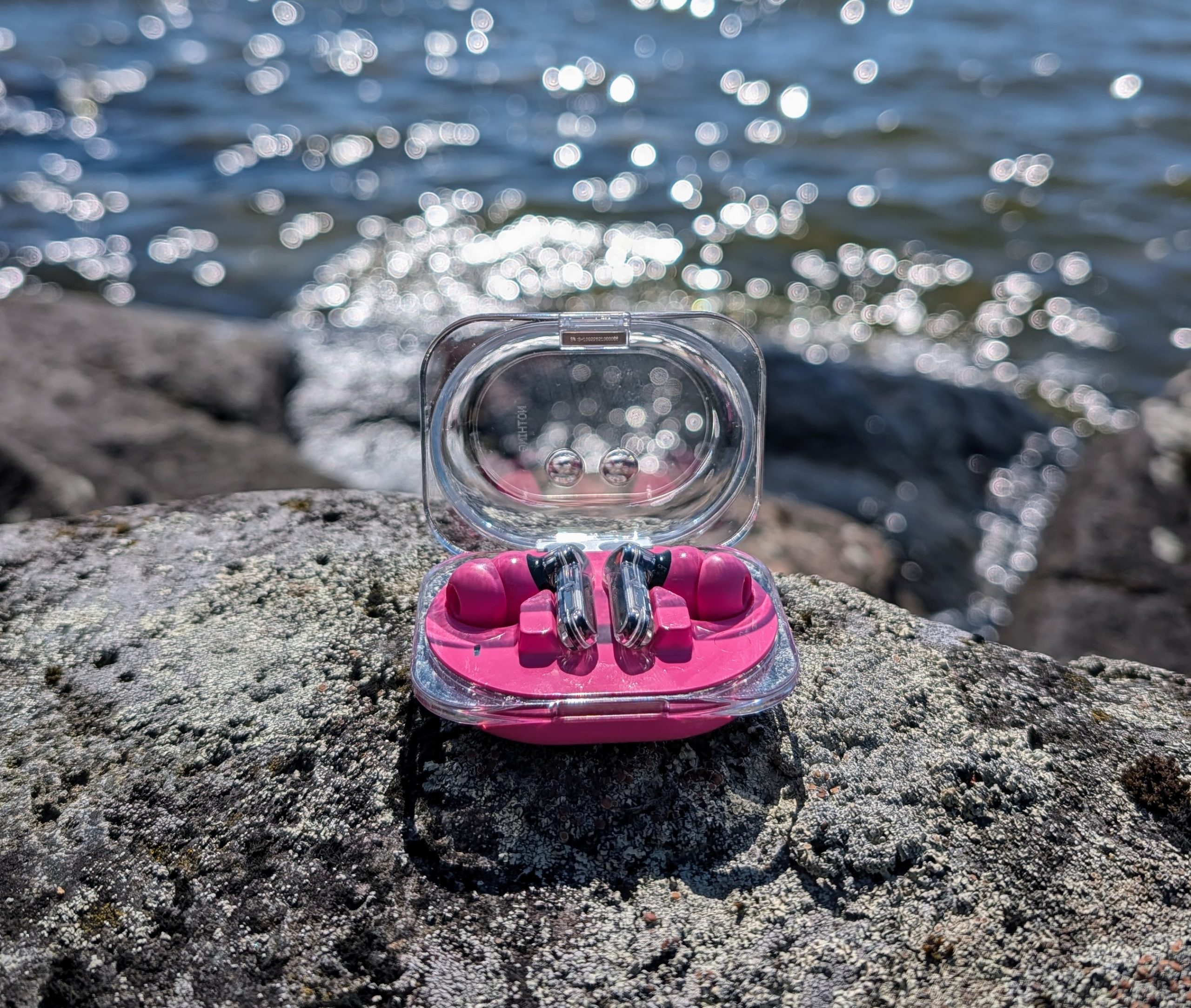

TL;DR
Nothing’s latest Ear (3a) earbuds continue the brand’s tradition of bold design and standout features at a competitive price. Boasting a punchy 12mm driver and support from the exceptional Nothing X app, these earbuds deliver impressive sound that punches well above their weight class. While the "party pill" inspired transparent case is a bit bulky, the lightweight buds offer a superb fit and IP54 protection for both the earbuds and the case. Standout features like Audio Snapshot—allowing you to record audio retrospectively—and AI-powered transcription set them apart, even if certain recording features are restricted regionally. With solid ANC and a class-leading EQ library, the Ear (3a) is a mid-range powerhouse that dares to be different in a sea of clones. Curious about how those 12mm drivers handle deep bass or how the retrospective recording works in practice? Dive into our full review to see if these are your next pair of earbuds.
Nothing is one of the few brands that truly dares to stand out, both in design and software, and has managed to build its own identity in a short time in an industry where much else looks the same. Now it is time for their affordable in-ear headphones to get a successor in the form of Ear (3a), the follow-up to the popular Ear (a). This is actually the first headphone from Nothing that we at Senses are testing, although we have previously tested one of their phones in the form of Nothing Phone (4a) Pro.
On paper, it is a surprising amount of headphone for the money. It features a new 12 mm driver, wideband noise cancellation designed to reach up to 45 dB, LDAC, Bluetooth 6.0, and even two new recording functions in the form of Audio Snapshot and call recording. Add to that Nothing’s sharp app and a recommended price of 1,290 kronor.
These are many promises for a mid-range headphone, but how well do they hold up in reality? Let’s find out!
Design and fit
We’ll start with Nothing’s hallmark: the design. Ear (3a) continues on the transparent track, and the earbuds themselves are really stylish. Nothing has built in a magnetic lock and a stainless steel hinge that allows the lid to open/close with a nice, precise feel, and each earbud weighs only 4.53 grams.

But then there is the case. Here, Nothing has done something that I honestly find hard to understand. The functional case itself, the pink core where the earbuds rest, is actually quite small. Around it, however, they have placed a thick, transparent frame with heavily rounded corners that makes the whole package swell and take up significantly more space than it should. An inherently small case is thus made unnecessarily large, and it’s hard to see it as anything other than form over function.
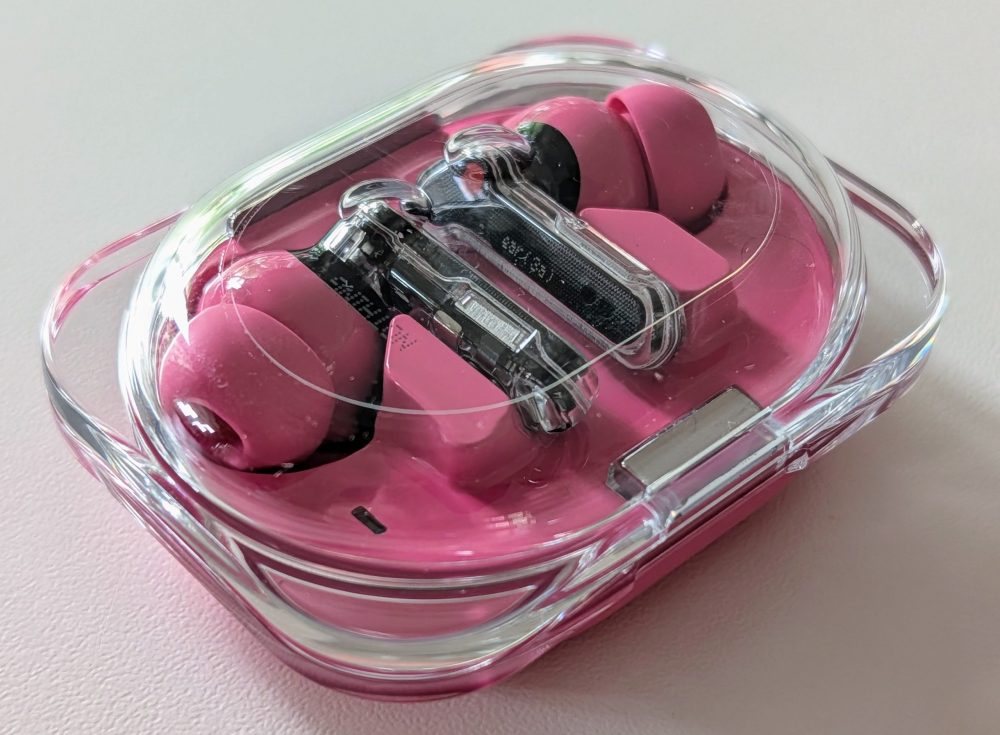
The design is certainly intentional. Nothing says they were inspired by pill blister packs and shrink-wrapped forms, and the transparent frame is meant to mimic a pill embedded in its blister. As an eye-catcher, it works, and it fits into Nothing’s playful “party pill” theme, but in my hand and in my pocket, I would have still preferred a compact case over this airy plastic frame. It’s stylish, but impractical.
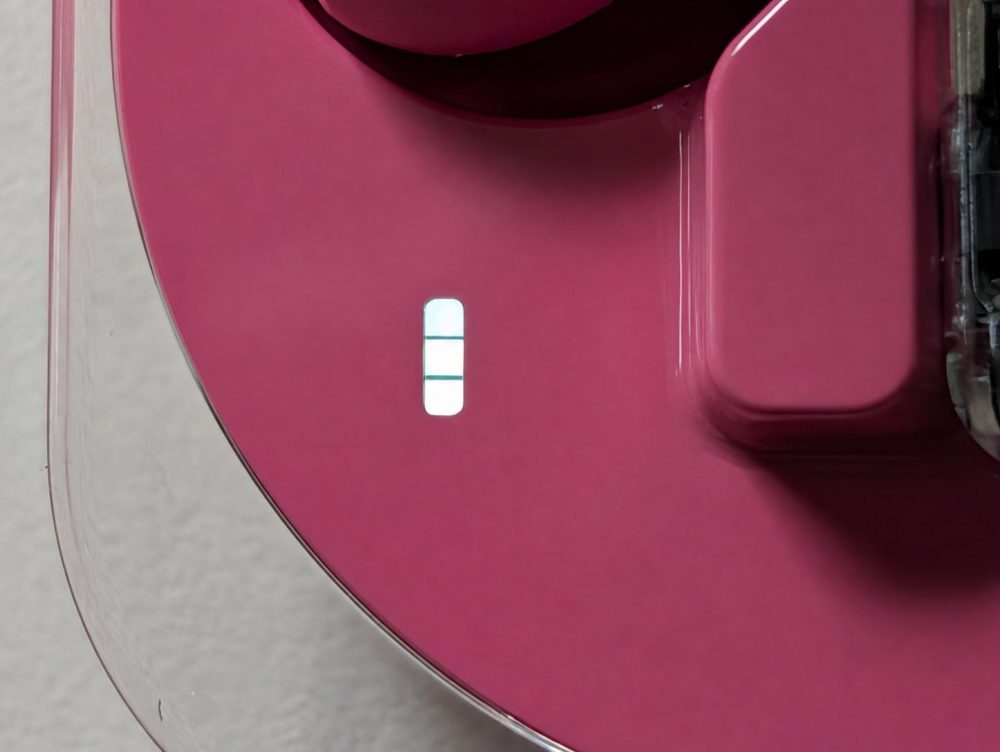
The case has a small LED status light; it glows in different patterns to show battery level, if the case is open, if the earbuds are pairing, and several other things. It’s a nice little detail.
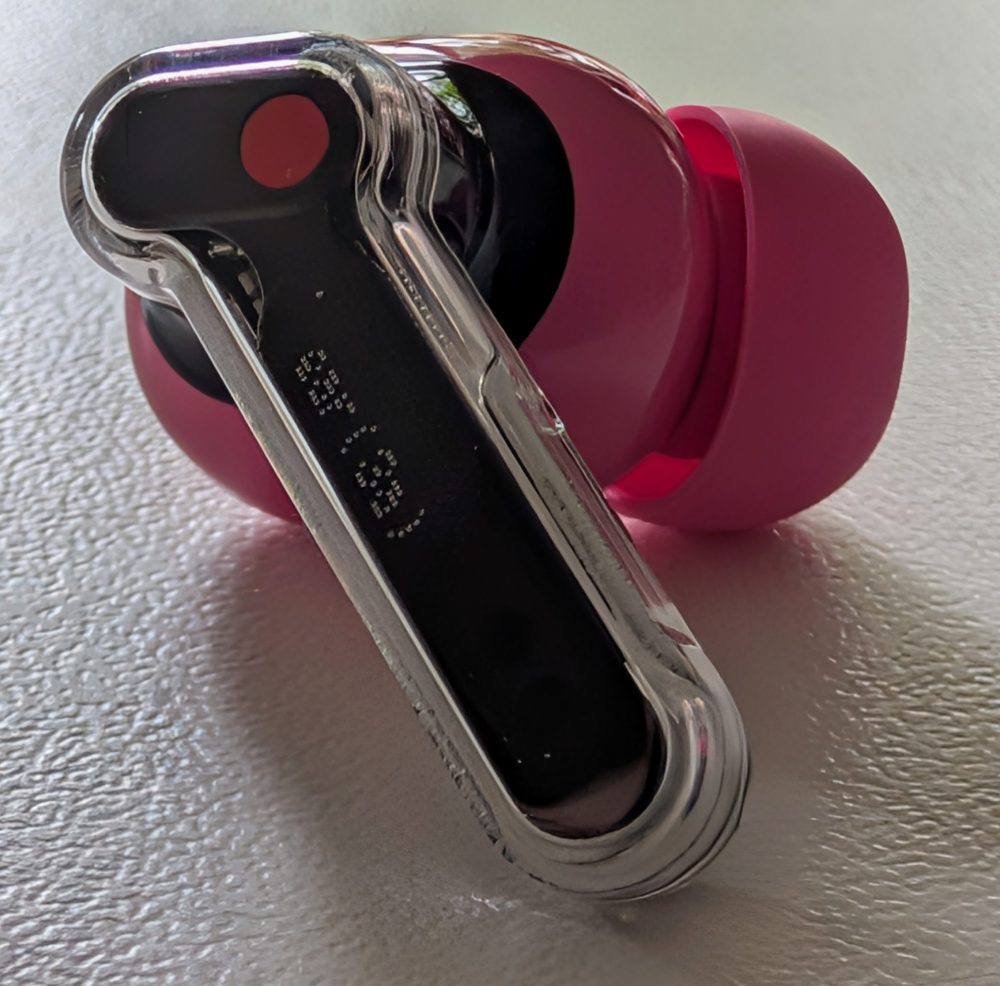
The ear tips are made of soft liquid silicone and come in four sizes: XS, S, M, and L, together with a new nozzle design intended to provide a tighter and more comfortable seal. And the fit is one of the headphones’ absolute strongest points. They sit very well in the ear and provide a tight seal, and the earbuds are so light that after a period of use, you hardly notice you’re wearing them. One detail worth highlighting is that the IP54 rating against dust and splashes applies to both the earbuds and the case itself. This is not at all a given; often only the earbuds are protected, so here you get a case that can also withstand some splashes. This is more than enough for sweat and a rain shower. It is worth noting, however, that IP54 is not as high a rating as IP55 or IP57 that some competitors offer.
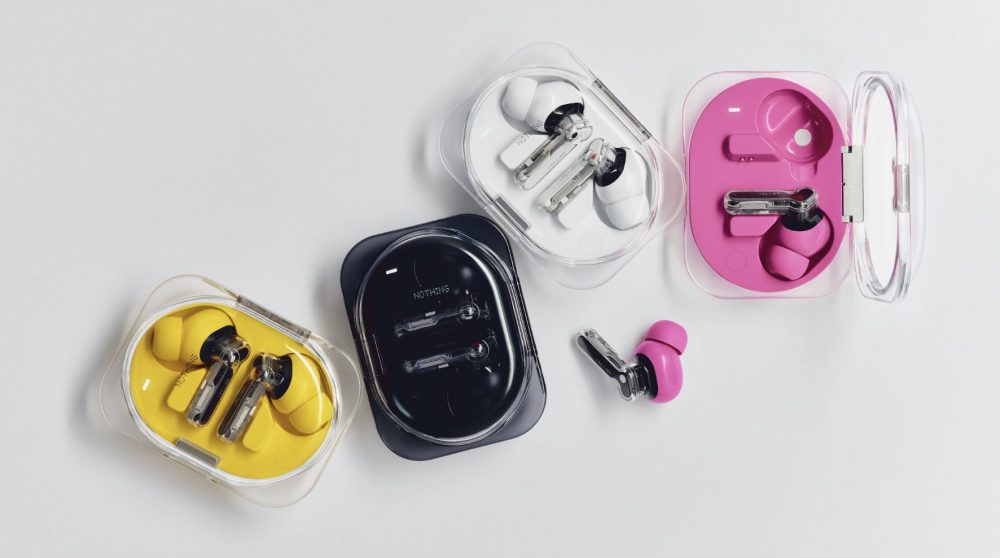
Color-wise, Ear (3a) arrives in four variants: classic black and white, as well as yellow and a brand-new pink. The choice of colors, especially pink and yellow, feels playful in a way that fits Nothing perfectly. If you want something more discreet, there is black and white, but it is the transparent finish and the bold colors that make the earbuds stand out from the crowd.
Sound quality and the app
In each earbud, there is now a 12 mm driver, an upgrade from the 11 mm found in Ear (a). Nothing promises up to 5 dB more powerful bass and has used a diaphragm in lightweight PMI to keep instruments and vocals clean. The sound turns out to be one of the headphones’ true strengths. The base tone is a fairly bass-heavy, V-shaped curve, but not excessively so, and most things sound really good right out of the box.
I fire up James Blake’s “Limit To Your Love” and the bass really pushes through, steady and with good control. Just like with the Soundcore Liberty 5 Pro, it is noticeable that these are single drivers rather than dual, so in music with more detail, the bass can take over slightly and bleed into the midrange. Sometimes the treble can also be perceived as a bit sharp, especially with ANC turned off. But this sounds very good for the price class, and I would say it’s on par with the Soundcore headphones, which cost considerably more.
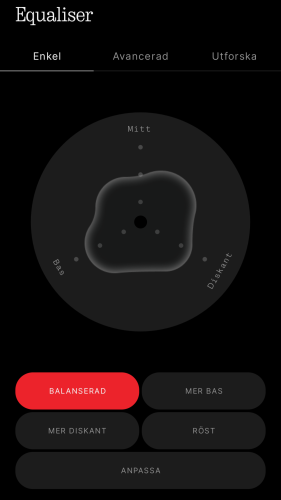
And should you want to fine-tune the sound, there is plenty of help available, because this is where Nothing truly shines. The Nothing X app is one of the best apps available, regardless of price class, perhaps even the absolute best. The really fun part is the EQ library, a sort of marketplace where you can download sound profiles created by other users and collaborating artists. It is a function I haven’t seen from anyone else, and it’s just that little bit quirky and outside the box, much like Nothing itself. They simply don’t just copy everyone else.
Controls are handled by pinching the earbud stems, which is a pleasant and reliable solution that avoids the problem of pushing the earbud further into the ear. Out of the box, you play and pause with one pinch, skip forward with a double pinch, skip back with a triple pinch, and hold to switch ANC modes or adjust volume. Everything can be changed in the app.
Sound-wise, there is support for LDAC with transmission up to 24-bit/96 kHz. On iPhone, as usual, you have to settle for AAC. New to Nothing’s a-series is also Static Spatial Audio, which is spatial sound without head tracking. Honestly, it feels mostly like a gimmick. It’s fun to try once, but not much more than that, and it’s not something I would leave turned on myself.
Active Noise Cancellation (ANC)
There are three levels of ANC to choose from plus an adaptive mode that adjusts to the surroundings, and of course, a transparency mode.
In practice, the noise cancellation is good for the price range. It effectively removes much of the low-frequency hum, that monotone carpet of sound from things like fans, engines, and traffic noise. Where it doesn’t quite suffice is with more high-frequency sounds, such as nearby voices, which slip through more easily. It doesn’t reach all the way up to the absolute best and most expensive headphones on the market, but for what it costs, it’s a clearly solid performance.
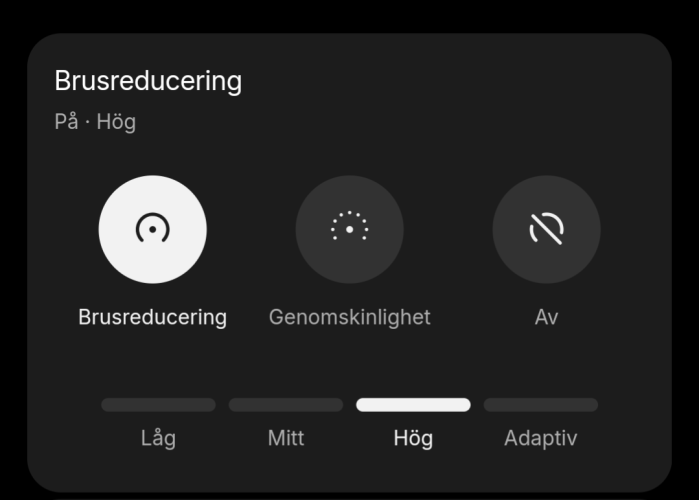
The transparency mode is really good. It doesn’t sound artificial in that muffled way that cheaper headphones often do, and it works perfectly well if you quickly need to talk to someone. A fun detail, albeit of the slightly less flattering kind, is that Nothing in the Swedish app has named the mode “Genomskinlighet” (Transparency). This is hardly intentional, but rather a very literal translation of the English word.
A nicer detail is that Nothing doesn’t use a tired recorded voice when switching between modes, but their own unique sound effects. Switching to transparency mode sounds almost like an exhale, a small but charming detail that feels typical for the brand.
Call quality
For calls, there are three MEMS microphones per bud, and Nothing uses a technology called Clear Voice which, according to the manufacturer, has been trained on 28 million scenarios to capture the voice and filter out traffic, wind, and other noise. There is also AI-based noise cancellation for calls.
After making several calls, I find that they are perfectly okay for the price tag, but nothing more. They are quite sensitive to wind, and they don’t come near what, for example, Huawei FreeBuds 5 Pro or Soundcore Liberty 5 Pro can handle, as both are in a completely different league regarding calls. But the calls don’t really stand out in any direction, neither positively nor negatively. As long as it isn’t too noisy around you, it sounds good. They simply do the job.
Audio Snapshot, call recording, and transcription
Ear (3a) has 32 MB of built-in storage in the earbuds, which allows you to record audio directly on them by pinching the earbud stem.
Audio Snapshot is Nothing’s way of capturing what you hear. By pinching both earbuds, you can save up to one minute of what is being played, such as a song or a podcast. The clever part is that you can also go back in time and save up to thirty seconds that have already passed before you even started recording. In total, it handles a maximum of 60 seconds, with a maximum of 30 seconds retrospectively. One catch to note is that specifically the retrospective recording requires LDAC to be turned off, so if you want to use that function fully, you have to sacrifice the high-resolution audio. The length of the clips is adjusted in the app.
Call Recording lets you pinch the earbuds during a call or meeting to record, up to two hours at a time. An audio prompt is played for everyone in the call so they know recording is active, which is good from a privacy perspective, but also makes it less useful if you want to record calls without notifying the person you’re talking to (which is actually permitted in Sweden).
And here comes the single most important caveat for us in Sweden: call recording is not available in the Nordic countries at the time of writing. Nothing states that the function requires necessary regulatory and legal approvals and that availability varies between markets, and that it is currently not available here. This is worth knowing, as it means one of the two major new features is entirely missing for Swedish buyers. Audio Snapshot, however, works as usual.
Recordings and Audio Snapshots are synced to the app, where you can share, play back, edit, speed up, and create transcriptions. You can also convert important parts of a transcription into shareable quotes. With Ear (3a), three months of Pro Transcription is included for free, with 120 minutes per month, for faster and more accurate transcripts. You are also supposed to be able to summarize recordings, identify speakers, and have reminders sent to your calendar, but the latter function is stated to arrive only from August, meaning not at launch.
Since call recording is not available in the Nordics, it is primarily the transcription of Audio Snapshots that is relevant here, and it actually works excellently in Swedish. I listened to a podcast, recorded a 60-second Audio Snapshot, and had it transcribed, and the result was very good. The only thing to keep in mind is that the transcription includes filler words like “eh” and “uh,” so if you want completely clean text, you’ll have to tidy it up afterward. Nothing states that they follow internationally recognized privacy standards such as ISO 27001, ISO 27701, and EN 18031.
Battery life and charging
Battery life is fully acceptable for the price range. Nothing states up to 10 hours on the earbuds and a total of up to 42 hours with the case when noise cancellation is turned off. If you turn on ANC, you land at up to 6 hours in the earbuds and a total of up to 25 hours with the case. In my use, those figures hold up quite well. It is worth knowing that if you use LDAC, and if you activate the retrospective 30-second recording in Audio Snapshot, it significantly drains the playback time. The difference is noticeable, so those wanting to maximize battery life will have to weigh that against having everything turned on at once.
Fast charging is okay: five minutes in the case gives about an hour of playback, and fully charging the earbuds takes around 70 minutes. Note that the case is charged exclusively via USB-C, and wireless charging is therefore missing.
Conclusion
On paper, Nothing Ear (3a) looks like a very competent mid-range headphone. You get a 12 mm driver, a well-developed app that is among the best in its class, LDAC, a stylish and playful design, and a battery life that lasts all day. The fact that all of this is contained in a package costing 1,290 kronor means expectations are high.
Overall, I am very satisfied. The sound is very good for the price range and stands up to more expensive competitors, ANC and battery life are of good quality, and Nothing offers some unique, fun features like recording and an app that is in a class of its own. The fact that they dare to think differently, both in design and software, is exactly what makes the brand fun.
The transparent frame that makes the case unnecessarily large remains a mystery to me, and the fact that call recording does not work in Sweden is a pity. But the overall result is a truly successful headphone for the money, and a clear recommendation in the mid-range.
If you want to compare with a direct competitor in roughly the same price range, EarFun Air Pro 4+ is a good alternative, with good sound, wireless charging, and even longer battery life for the money. Nothing responds with a more stylish design, a better app, and the new recording functions. If you instead want to step up and spend more money on pure sound and truly excellent call quality, the Huawei FreeBuds 5 Pro are hard to beat.
Nothing sent review samples for this test. Senders of material have no editorial influence on our tests; we always write independently with you readers and consumers in focus.
How we rate products at SensesReview Highlights: Q&A
How much do the Nothing Ear (3a) earbuds cost?
The recommended price is set at 1,290 kronor.
Are the earbuds and the charging case waterproof?
Both carry an IP54 rating for dust and splashes.
Does the Nothing Ear (3a) case support wireless charging?
No, the case is charged exclusively via USB-C.
How long does the battery last with noise cancellation on?
You get up to 6 hours in buds and 25 with the case.
Can I use the call recording feature in the Nordic region?
No, this feature is not available in Nordic countries.
How much audio can I save with the Audio Snapshot feature?
You can save up to 60 seconds of what you are hearing.
What sizes of ear tips are included in the box?
They come with four sizes of silicone tips: XS, S, M, L.