
TL;DR
Segway is shaking up the garden tech market with the Navimow i208E AWD, a mid-range robot mower designed to balance simplicity for beginners with power for pros. Boasting all-wheel drive and a nimble three-wheel design, this mower handles slopes up to 45% and maneuvers tight spaces with ease. The standout feature is its wire-free installation; using RTK satellite positioning and an AI-powered camera, it navigates your lawn without the need for buried boundary lines. While the manual cutting height adjustment and narrow cutting width are minor drawbacks, the i208E impresses with its robust build and smart obstacle avoidance. At a highly competitive price point, it is a compelling alternative to established legacy brands. Curious how its AWD system handles tricky terrain or if the AI camera can really save your garden? Read the full review to see if this is the ultimate upgrade for your lawn.
Segway has for some time been targeting the ever-growing market for robot lawn mowers, and now they are here in earnest. In the mid-range segment, we find the i2-series, which Segway positions as a mower for both ends of the spectrum. It is intended to be capable enough not to disappoint an experienced robot mower owner, but at the same time so simple that even a first-time buyer feels at home right away.
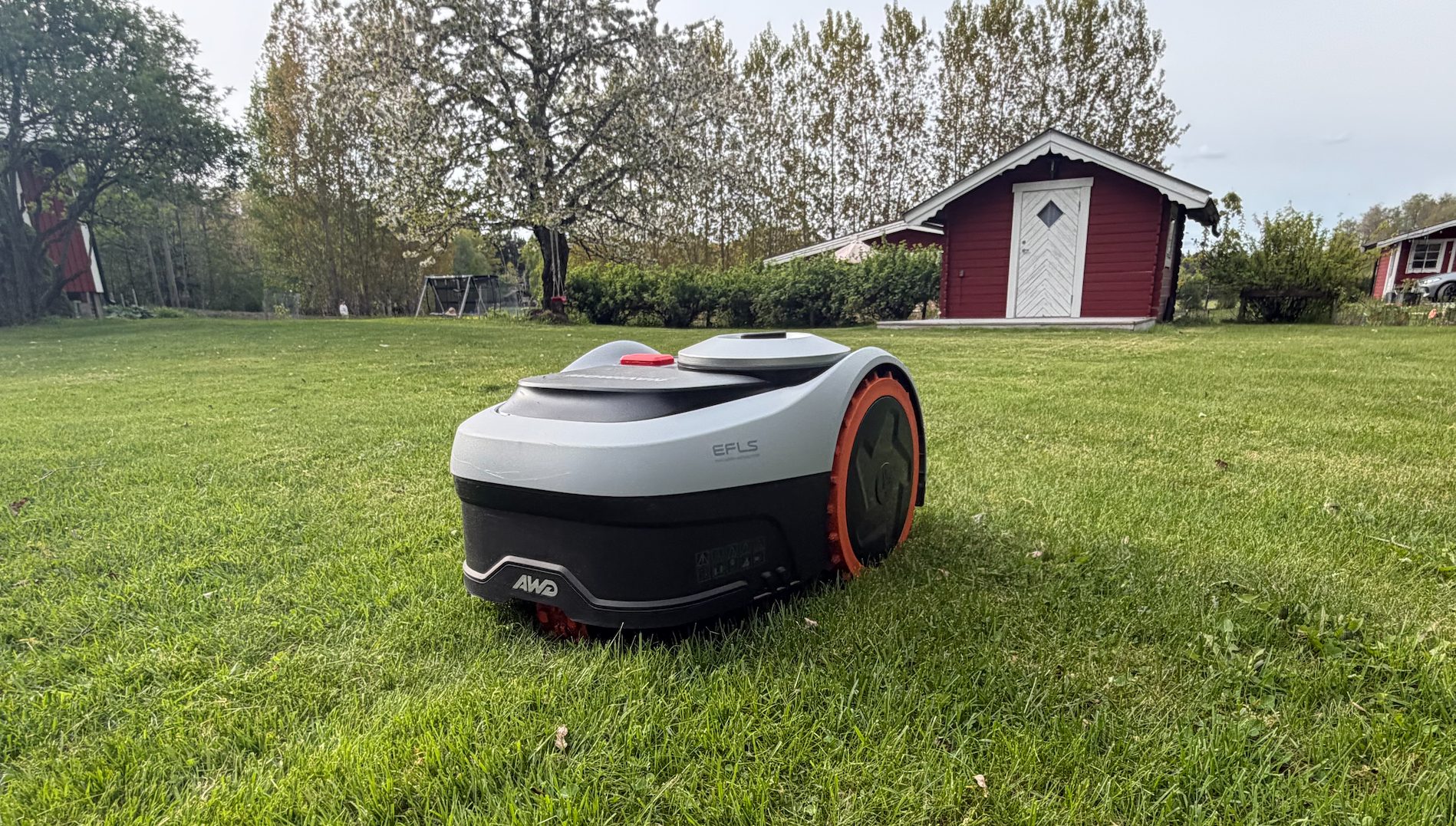
We have tested the Navimow i208E AWD, the model that takes on plots up to 800 square meters with three-wheel all-wheel drive and a camera in the front. But is it enough to challenge the more established names in the garden, and is the all-wheel drive more than just a line in the specification? We are going to find out!
Models and Variants
Before we get into the actual mowing, it is worth sorting out the variety of models, as the i2-series is available in several versions that are easily mixed up. The one we are testing, the i208E AWD, navigates with satellite positioning (Network RTK) in combination with a camera in the front, and can handle up to 800 square meters. If you want something smaller, there is the i205 AWD for up to 500 square meters, which is essentially the same machine but with a smaller battery.
There is also a separate and more advanced model that navigates with LiDAR. This is a completely different product with a different cutting width and app-controlled cutting height, adapted for denser and more shaded gardens. If you have a lush plot where the sky is often obscured, that is the variant you should look at, but you will also have to pay quite a bit more. We recognize the approach from our recent test of the Roborock RockMow Z1, which divides its range in the exact same way between an RTK model for open areas and a more expensive LiDAR model for trickier gardens.
Design and Build Quality
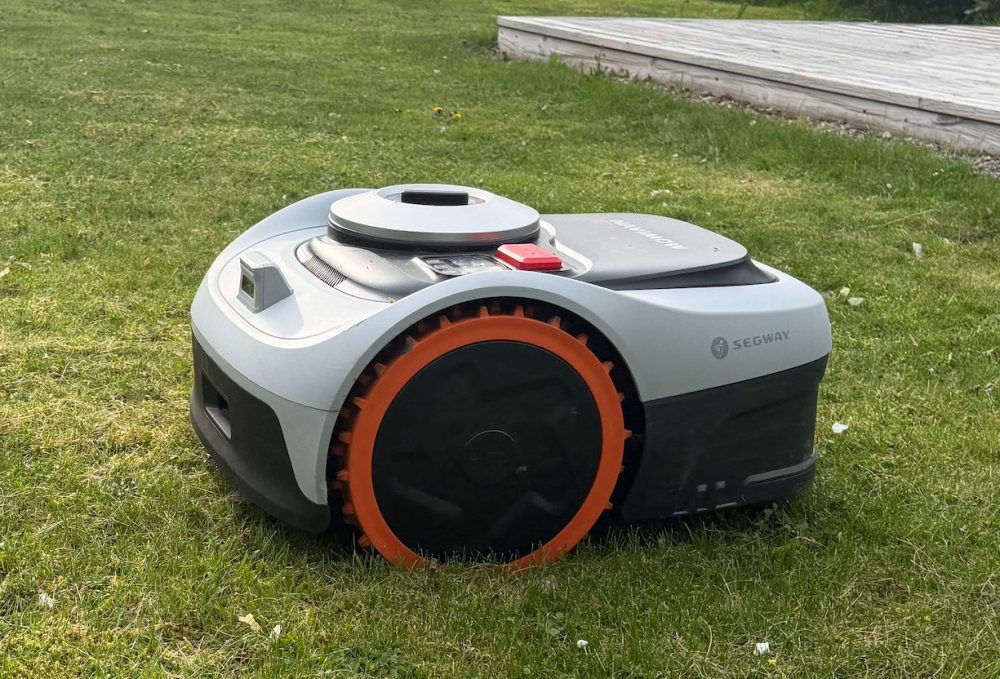
The Navimow i208E has a plastic outer shell, but it does not feel “plasticky.” The robust all-weather wheels, the blades, and the build quality are more than adequate, and feel like a step up compared to the price. Of course, there is a difference compared to some of the more expensive competitors that look more like they belong in a new season of Robot Wars, but the design here is subtle and maintains a lower profile.
A really nice detail is that you can turn off everything that glows and flashes, so it doesn’t draw more attention to itself than necessary. It is also rated according to IP66, which means it can withstand both rain and being rinsed off with a garden hose after a muddy day.
Installation and Mapping
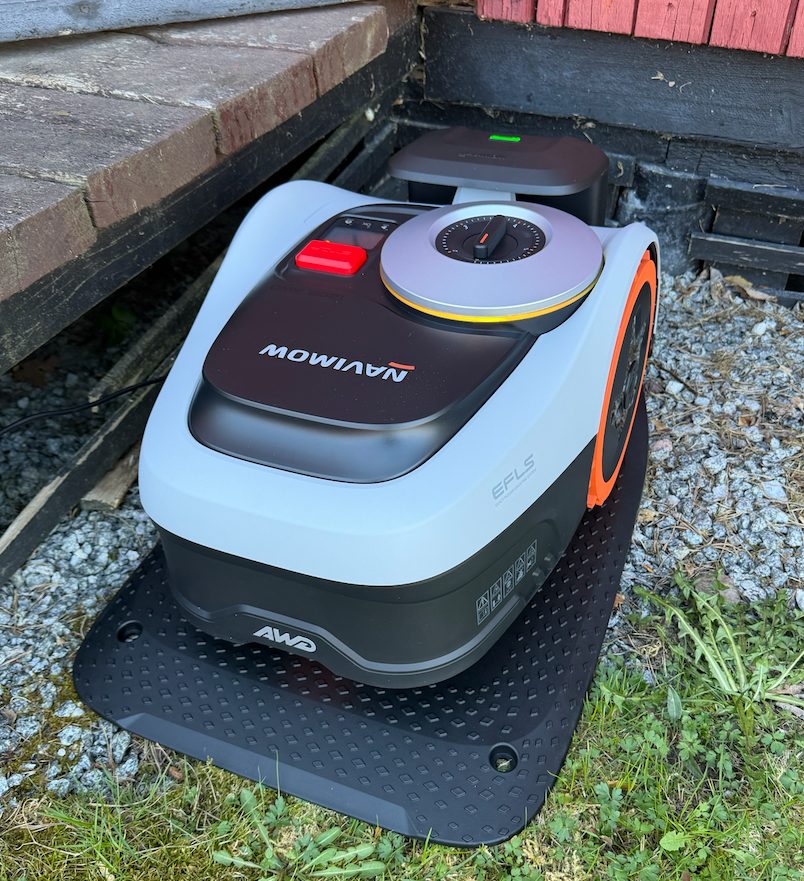
Straight out of the box, it’s fairly self-explanatory what needs to be done. It comes with good instructional material with links to both the app and website, and a clear quick-start guide. The installation itself is super simple. You download the Navimow app, start the unit, and follow the instructions to pair via Bluetooth and set up Wi-Fi, so you can control the machine and perform system updates before it’s time to get started. The pairing went flawlessly, and the next step is to place the charging station, map the area, and send it off on its maiden voyage.
The biggest advantage compared to older models and brands is that you don’t need to bury any boundary wire. Instead, it keeps track of where it is with RTK, and it’s worth explaining how that works. Standard satellite positioning—the GPS most people know from their phones—has a margin of error of several meters, which is far too coarse for a mower that needs to stay within the lawn. RTK adds a correction signal that reduces the margin of error to centimeter level, so the mower knows exactly where it is. Normally, you get that correction from a fixed reference antenna that you set up on the plot, similar to the antenna at the base station of the Roborock RockMow Z1.
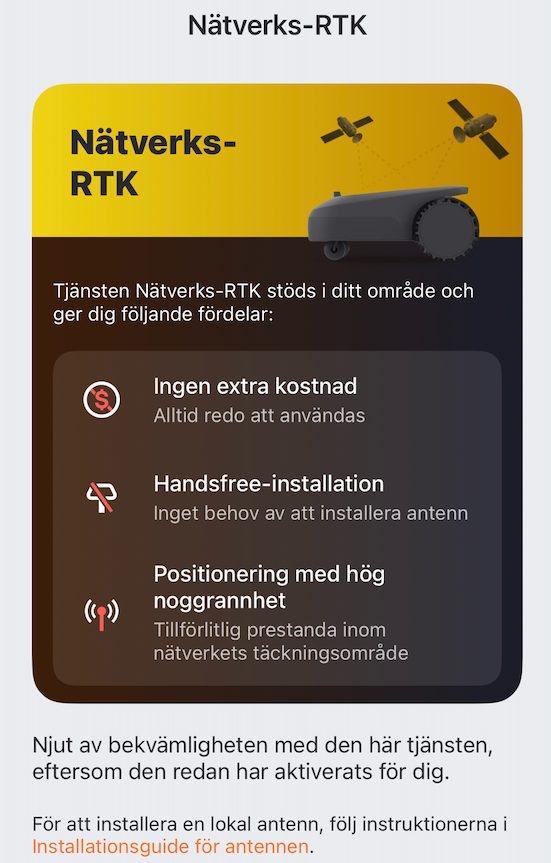
The clever thing about the i208E is that it instead fetches the correction over the mobile network, from an established network of fixed reference stations. In Sweden, and in most of Europe, you therefore don’t need to dig or erect any antenna at all. The machine combines this with the camera in the front, and by manually syncing the charging station’s position, it knows where the route goes and finds its way back when it’s time to charge or when it’s finished mowing. The antenna is still included in the box and can be good to have in your back pocket if you have areas with poor coverage or dense tree canopies where the signal becomes weak.
To map the boundaries in the garden, you use your smartphone as a remote control. It is harder than you might think to steer a lawn mower that only has one rear wheel, so my tip is to first just drive around with it to get a feel for how it moves before you start drawing the map. Changing an already finished map is actually more complicated than you might expect.
Terrain, Maneuverability, and All-Wheel Drive
But now to the fun part. This is where the i208E gets to show why AWD is in its name. Unlike simpler mowers, it can apply power to all three wheels. Normally, it is only driven by two, while the third wheel rolls along without being powered, but as soon as the terrain requires it, the drive engages there as well. In this way, it saves energy on flat ground and only uses full power when truly needed, such as on hills and uneven ground. On paper, it can handle slopes of up to 45 percent, which corresponds to around 24 degrees.
Since the i208E has a single rear wheel, it truly turns on a dime. This is both a blessing and a curse. It provides an incredibly tight turning radius, but because the wheel is an all-weather wheel and it turns quite decisively, it can easily leave marks in the lawn if it is a bit damp.
In our garden, there were a trampoline, currant bushes, and several trees, but it managed to steer clear of all of them. The neighbor’s old mower usually gets stuck and panics under their trampoline, but the i208E managed to mow under it and find its way out again without problem. On the map, you can see the four legs marked in gray because it chose to go around them. It also handled the wooden deck and all the trees without the slightest issue. It’s clear that maneuverability is something Segway prioritized, and it’s also what most clearly distinguishes it from cheaper alternatives. For truly large, steep, and hilly plots, a heavier machine like the RockMow Z1 is naturally in a different league, but for a standard residential garden, the i208E gets around with a comfortable margin.
Mowing and Edges
The actual measurement is done by walking right behind the lawn mower and trying to keep to the outer edge of the lawn to create the outer zones. When you are finished, you ask the mower to return to the charging station to complete the analysis. The app then calculates a map and the size of the lawn, and after that, you just let it mow.
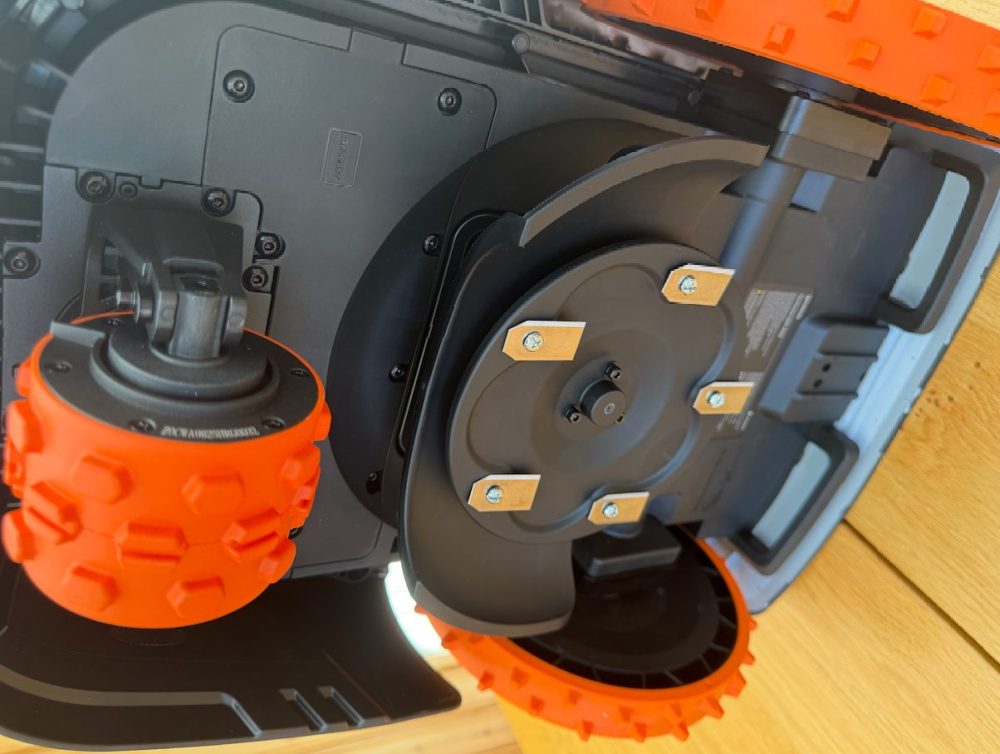
The first mowing session is significantly slower because it maps the surface at the same time. The cutting width is quite narrow at 18 centimeters, with five blades on a cutting disc, and it leaves nice, clear lines where it has passed. You set the cutting height in ten steps between 20 and 60 millimeters, but unlike most other things, this is not handled in the app but with a mechanical dial on the machine itself. This means you have to go out to the mower every time you want to change the height, which feels a bit old-fashioned in an otherwise highly connected product. However, since it mows according to a schedule, you can lock in a height that cuts just right and instead mow more often, so in practice, it’s not something you tinker with very often.
One thing that is missing, however, is a floating cutting deck—meaning the deck with the blade disc can move freely and follow the contours of the ground. On more expensive machines, this ensures the cutting height remains even even over bumps and dips, similar to the RockMow Z1. On the i208E, the cutting deck is fixed, so on very bumpy ground and in deeper pits, the result isn’t as consistently even. On a standard, reasonably flat residential plot, it’s barely noticeable, but if you have many irregularities, it’s worth keeping in mind.
Something Segway is keen to highlight is that the i208E features AI and a camera in the front. It is supposed to recognize over 150 different animals, plants, and toys to avoid them, and in most cases, it works well. The trampoline, the deck, and the trees were no problem. However, I should have made the tulips a no-go zone, because it turned out the hard way that small tulip bulbs were not on the list, to the horror of my mother-in-law. Small and thin objects are thus not always handled by it, so a quick check for items lying on the grass before starting is recommended.
Edges are a chapter of their own. The i208E actually drives impressively close to the edge, so the maneuverability itself is not the problem. The limitation lies instead in the fact that the cutting disc sits a bit inside the chassis, so even when the machine follows the edge neatly, a narrow strip remains closest to walls, fences, and flowerbeds that the blades simply cannot reach. It’s about 8-10 centimeters of uncut grass at the very edge, and this is not unique to this model but applies to most robot lawn mowers. Unlike more expensive machines like the RockMow Z1, where a special edge module can reduce the distance to a few centimeters, here you should expect to go over it with a trimmer if you want it razor-sharp all the way out.
The App and Software
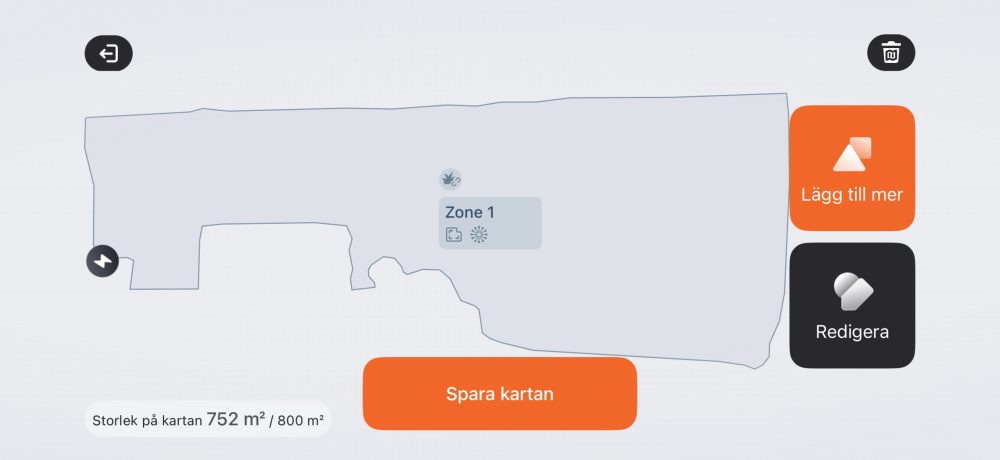
The Navimow app has most of what you could want. There are three levels of mowing: fast, normal, and precision. You can set a schedule, let it avoid rain, heat, and darkness, and there are extra settings for avoiding animals, where the camera scans further ahead and turns earlier than for other objects. Beyond that, there are settings for anti-theft and alarms, as well as the ability to update it wirelessly. The only thing you can’t access from here, as mentioned, is the cutting height; that is handled on the machine itself.
The settings for darkness and rain are of course smart, but they seem to be controlled by a weather service, so they don’t always correspond to reality. The same goes for the battery logic, where I would have liked a bit more intelligence. Right now, it goes back to charge when it has 15 percent left, and then charges to a full 100 percent before heading out again. This resulted in it being 98 percent finished with the lawn, and despite having enough battery left for the last little patch, it chose to take a long break to charge for a couple of hours. Then it decided it had become too dark to finish mowing and instead continued at five in the morning when it got light. I would have preferred it to, like an electric car, sense that a short charge is enough to finish and then charge fully afterward. Furthermore, since the schedule was set for Monday and Thursday, and it only managed 98 percent on Monday, it did the last two percent on Thursday and was then idle for the rest of the day. You really have to think things through when setting your schedule.
The app is also good at sending notifications—sometimes a bit too good. Normally, it notes every time it has to charge, which can be three times in a day if you maximize the area, plus it tells you when it’s done or when it gets dark, and if it’s raining or if it gets stuck. A typical mowing session of nearly 800 square meters with some minor issues or rain can easily generate a dozen push notifications, when you actually buy a robot lawn mower to avoid thinking about lawn mowing. Fortunately, deep in the menus, you can choose to only receive system messages instead of everything.
It is also worth mentioning that free data traffic and positioning are included for the first year. After that, the 4G subscription costs 29.9 euros a year if you want to keep remote control and GPS anti-theft outside your own network. However, the actual mowing works as usual even without it, so it’s not a service you’re forced to subscribe to.
Conclusion
The battery life is on the shorter side. The i208E manages to mow around 250 square meters before it’s time to charge, but that is also one of the reasons why the price can be kept down. It mows for about two hours and then charges for about two hours, which is no problem if you are diligent and set the schedule so it mows regularly. If the grass is long, however, it becomes annoying that it needs to charge so often, and a full 800 square meters takes well over half a day.
It’s also a bit of a shame that the camera is only used internally. You can’t connect and watch while it mows, or get a photo of what is in the way—something some more expensive mowers can do. At the same time, this is a model that suits most people. It has all-wheel drive, it is relatively smart, and it has all the functions you need to simply let it mow the grass and free up time and energy for the owner.
Then there is the matter of price. The recommended price is 12,999 SEK, but it has already appeared on promotion for under 10,000 SEK, and that is where it becomes really interesting. For a machine that gets around almost everywhere, requires minimal installation, and costs a fraction of the most expensive ones, the i208E is a very easy choice to recommend.
Segway sent a test unit for this review. Senders of material have no editorial influence on our tests; we always write independently with you, the readers and consumers, in focus.
How we rate products at SensesReview Highlights: Q&A
Does it require a boundary wire?
No, it uses RTK satellite positioning and a camera.
What is the maximum lawn size it can handle?
It is designed for plots up to 800 square meters.
How do I adjust the cutting height?
Use the mechanical dial located on the machine itself.
Can it handle steep slopes in my garden?
Yes, it manages inclines of up to 45% or 24 degrees.
Does it cut the grass all the way to the edge?
It leaves an uncut strip of about 8-10 cm at the edges.
Is it safe to wash it with a garden hose?
Yes, its IP66 rating allows for easy hose cleaning.
How much does the mobile data subscription cost?
It is free for one year, then costs 29.9 euros annually.