
TL;DR
DJI is expanding beyond drones with the Power 1000 Mini, a rugged 1 kWh portable power station designed for off-grid adventures and emergency backup. Featuring long-lasting LiFePO4 chemistry and lightning-fast charging—hitting 80% in under an hour—this unit is built to last for over a decade of daily use. While its 11.5 kg weight and reliance on some outdated USB-A ports are minor drawbacks, the addition of a 10ms UPS mode, a smart app, and an integrated retractable USB-C cable makes it a formidable contender in the power market. Whether you are a van-lifer, a field professional, or just looking for a reliable home backup, the Power 1000 Mini offers a premium blend of performance and durability. Is this the ultimate compact power solution for your next trip? Read the full article to discover why this powerhouse might be your next essential piece of gear.
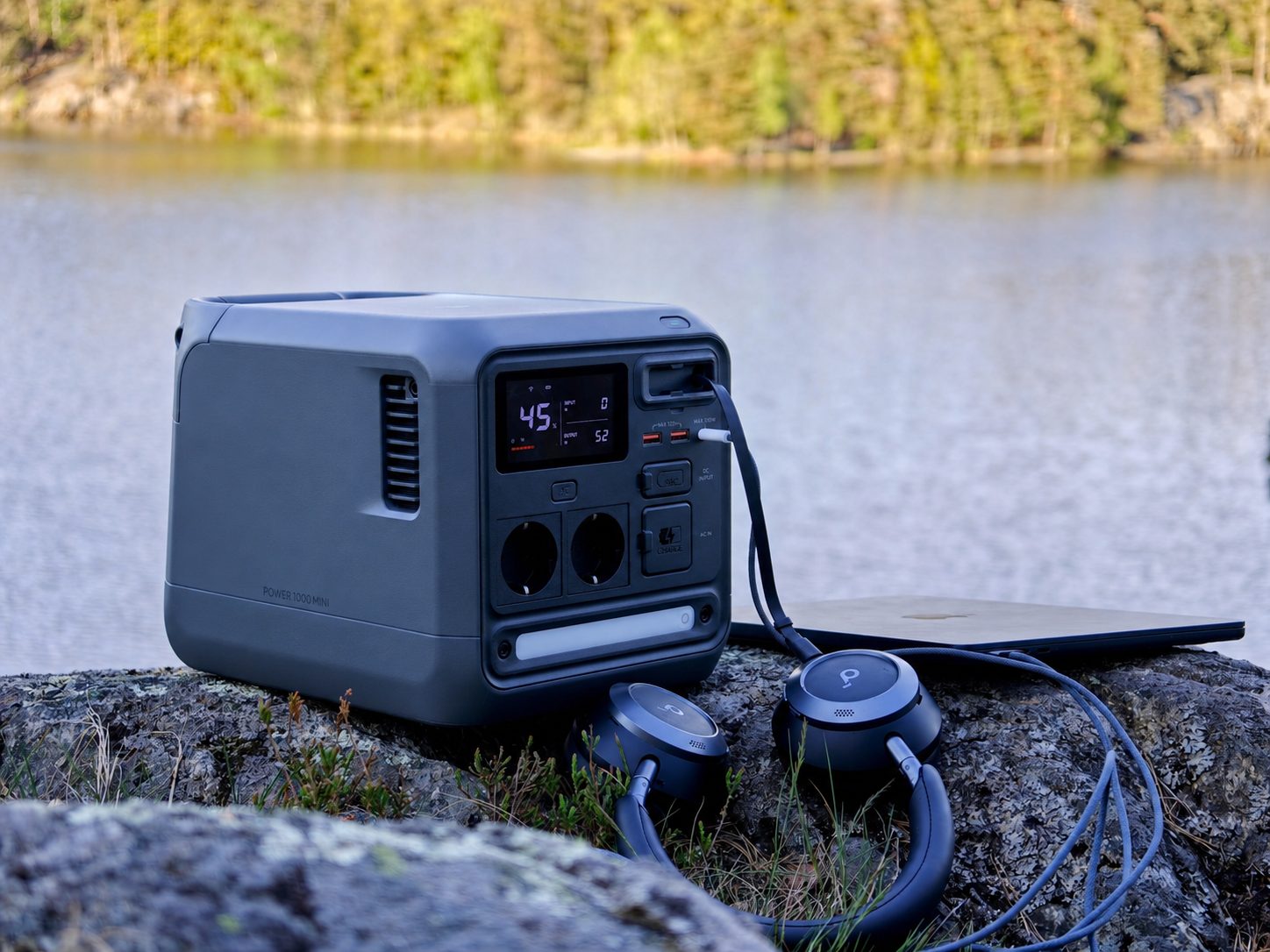
Over the years, we have tested several different products from DJI, but it is still a name most people solely associate with drones. However, the company has significantly expanded in recent years, stepping into an entirely new product category: portable power stations. Now, we are testing the DJI Power 1000 Mini, a compact 1 kWh station. Is it worthwhile, or just an extremely bulky power bank? Let’s find out!
Design and Build Quality
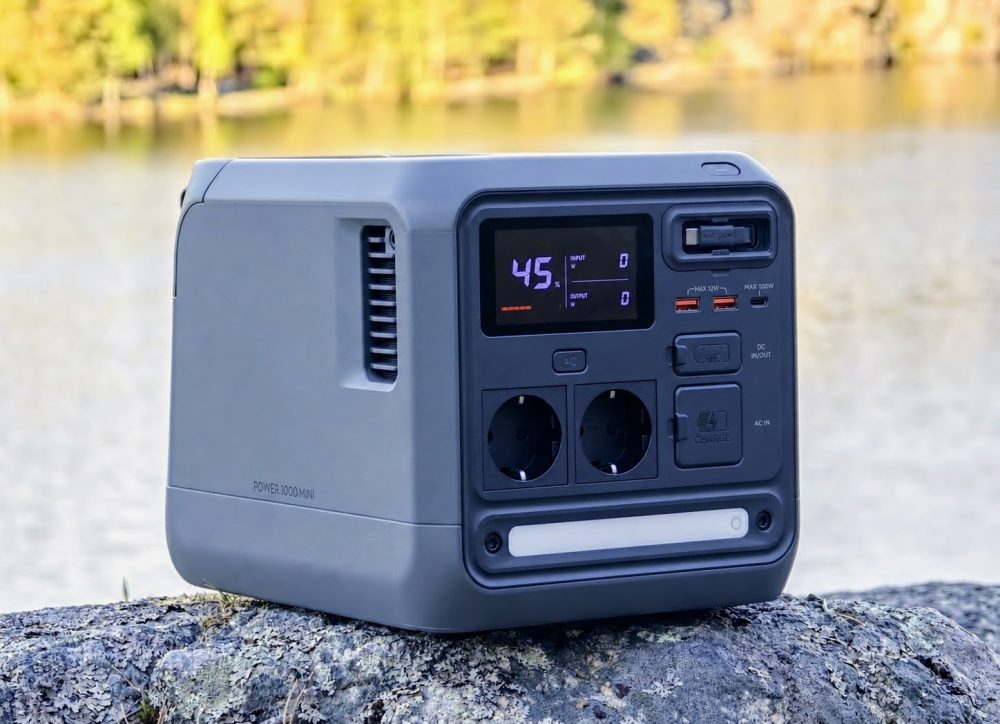
The first thing you notice when unboxing the DJI Power 1000 Mini is how solidly built it feels. The chassis is constructed from a flame-retardant, matte gray polycarbonate material.
The dimensions land at 314 × 212 × 216 mm, with a weight of approximately 11.5 kg. It is a substantial piece of equipment to carry (read: lug) around, even though DJI has managed to shave off over 3 kg compared to the original model without losing any significant battery capacity.
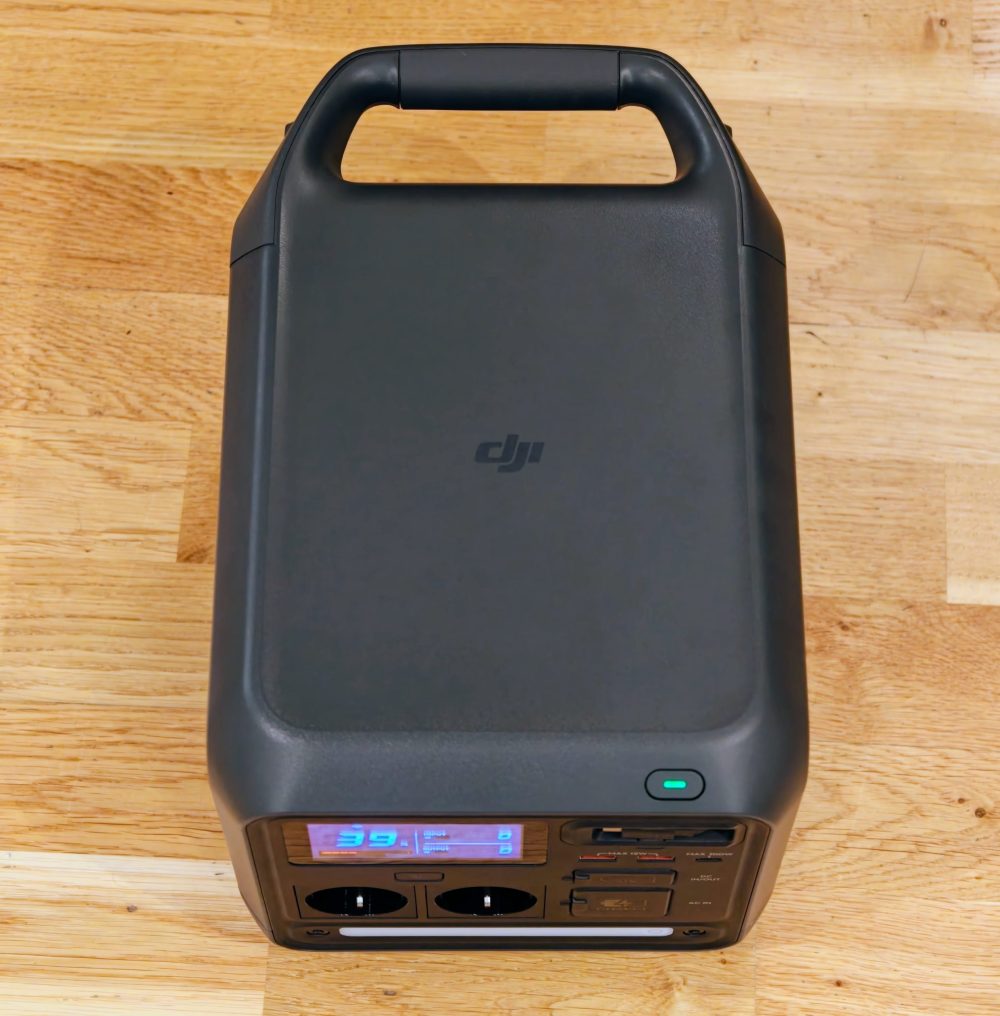
To make those eleven-plus kilos a bit more manageable, there is an integrated carrying handle at the top of the unit. It is well-placed and smartly balanced, so it works excellently for carrying with one hand over short distances. However, if you need to carry the unit over longer distances, an extra handle on the opposite side would have been welcome so it could be held with both hands.
A truly smart design choice is that all connections (including AC in), buttons, the screen, and the lighting are clustered on the front. This means you don’t have to move the unit to access ports when it is placed in a tight spot. Both the AC input and the SDC port are also equipped with tight-sealing silicone covers that protect against dust and moisture.
What we do miss, however, is some form of official IP rating. Given that a large portion of the target audience includes campers, van-lifers, and outdoor enthusiasts, this is a bit of a missed opportunity.
There is an LCD screen that displays information regarding input and output power, battery level, remaining runtime, and any warnings. The screen is easily readable even in bright sunlight.
At the bottom of the unit, there is a wide LED lamp that functions as task or ambient lighting. It can be dimmed up or down and also features a dedicated emergency mode that flashes SOS.
Battery and Charging
The battery has a capacity of 1008 Wh, which places the unit squarely in the 1 kWh class. Compared to a large power bank like the Anker Laptop Power Bank, it offers more than 10 times the capacity. The battery uses lithium iron phosphate (LiFePO4) chemistry; DJI states that the unit should retain over 80% of its original capacity even after 3,000 to 4,000 full charge cycles. In practice, this means you could fully discharge and recharge it every single day for over ten years.
The charging speed is impressively fast. The unit is capable of charging from 0 to 80% in under an hour, and a full 100% charge in under 80 minutes.
For off-grid charging, there is an integrated MPPT module that accepts up to 400 W from solar panels via the SDC port. It is also possible to charge in a car via a 12V/24V socket with the same 400 W maximum input, resulting in a full charge in approximately 160 minutes. An adapter cable (which is not included) is required for solar panel charging or car charging.
Ports and Connections
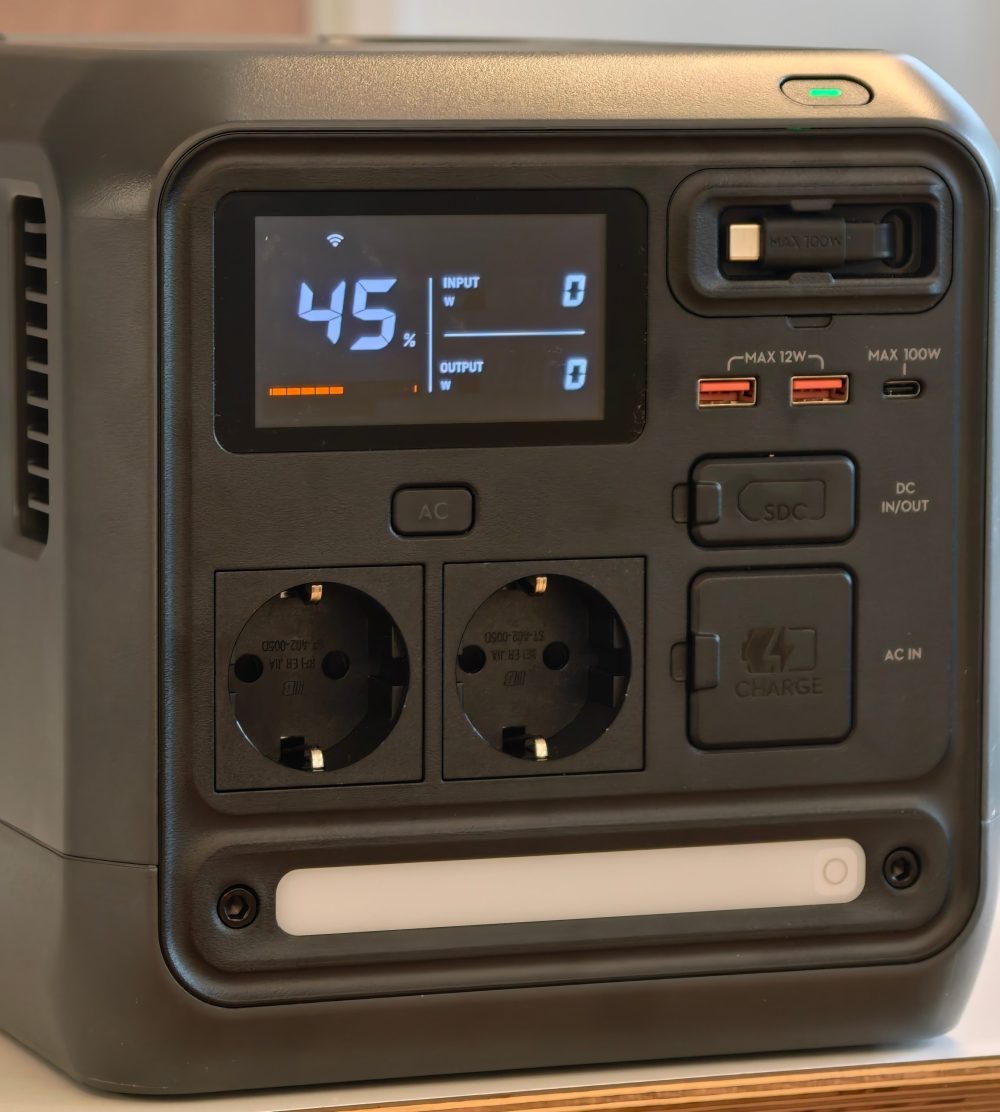
On the front, we find two AC outlets, two USB-A ports, one fixed USB-C port, an integrated retractable USB-C cable, and the SDC port.
The AC outlets deliver up to 800 W of continuous power during battery operation, with a peak of 1000 to 1200 W for short-term surges. This is fully sufficient for laptops, lighting, refrigerators, etc., but not enough for all kettles, coffee makers, or microwave ovens. However, when the unit is plugged into a wall outlet, a Bypass mode is activated that routes the current directly through the unit, allowing the AC outlets to deliver a full 2200 W.
On the USB side, things get a bit strange. There are two USB-A ports and only two USB-C ports, one of which is the fixed retractable cable. This is an odd choice for 2026. USB-A feels like a thing of the past, and most of us today have significantly more devices that charge via USB-C than via USB-A. That DJI chose to split the ports this way instead of, for example, opting for four USB-C ports feels poorly thought out. Furthermore, the USB-A ports are standard 5V/2.4A ports without fast charging support, delivering a maximum of 12 W per port.
The USB-C ports, on the other hand, are excellent. Both support Power Delivery 3.0, PPS, Quick Charge 3.0/5.0, and can deliver up to 100 W per port. The integrated retractable USB-C cable is approximately 80 cm long and is held in place with magnets in the chassis. However, there is a limitation here worth noting: the total shared output power for USB-C is a maximum of 150 W, so if the retractable cable is drawing a full 100 W, the other USB-C port is throttled to 50 W.
The SDC port is DJI’s own proprietary connection that can deliver up to 300 W and receive up to 400 W during charging. It works excellently for fast DC-DC charging of compatible DJI batteries, but can also be used for car and solar charging (if you purchase a special adapter cable). The only minor downside is that there is only one SDC port, which means you cannot charge the unit via solar panels and fast-charge other batteries simultaneously.
App
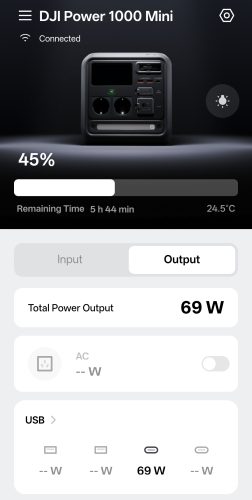
There is built-in support for Wi-Fi and Bluetooth. Everything is controlled via the “DJI Home” app.
And this is where it gets a bit disappointing. Have an iPhone? Congratulations, you download the app from the App Store and everything works as it should. Have an Android? Then it’s the same hassle we’ve seen from other Chinese manufacturers (read: Huawei). The app is not in the Play Store; instead, you have to download an APK file directly from DJI’s website. The phone warns of “unknown apps” and “potential security risks,” and it feels generally insecure and cumbersome.
Once inside the app, it is well-built and stable. The overview screen clearly shows the current battery level, temperature, estimated remaining runtime, and live power for each port. Here, you can also quickly toggle the AC outputs, USB ports, and lighting on and off.
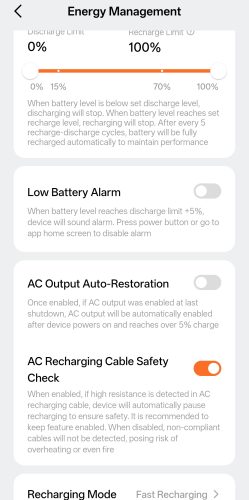
Under “Energy Management,” you can set both a minimum discharge limit and a maximum charging limit—for example, that the unit should never be charged above 70%, which spares the battery and extends its lifespan for those who leave it permanently plugged in. There is also a low-battery warning, an automatic AC output reset after a power outage, and a safety mode that detects if a subpar charging cable is connected.
It is also in the app that you switch between the three charging modes: Fast Recharging, Standard, and Silent. For those who need to sleep next to it at night, the Silent mode is valuable, even though the standard mode is already very quiet.
UPS Function
One truly useful feature is the UPS mode. In the event of a sudden power outage when the unit is connected between the wall and your equipment, it switches to battery power in just 10 milliseconds. We tested this with a connected Wi-Fi router, and when we cut the power, the switch to battery operation was so fast that the router didn’t notice a thing.
Conclusion
The DJI Power 1000 Mini is an impressively well-engineered portable power station that proves DJI can truly do more than just drones. The build quality is absolute top-tier, charging is incredibly fast, it works excellently as a UPS, and the app offers smart features that are actually useful.
There are, however, a few things that slightly dampen the impression. It is still large and heavy, even if it is more compact than its predecessor. The port distribution with two USB-A but only two USB-C ports feels strange. The lack of any IP rating is also disappointing.
The DJI Power 1000 Mini has a recommended price of approximately 6,499 kronor, which is a lot of money, but for those who work extensively in the field, live the van-life / camp a lot, need reliable emergency power/UPS at home, or simply want a power station that can handle most things, this is an excellent choice.
DJI sent a review sample for this test. Senders of material have no editorial influence on our tests; we always write independently with our readers and consumers in focus.
How we rate products at SensesReview Highlights: Q&A
How much does the DJI Power 1000 Mini weigh?
It weighs around 11.5 kg and has one handle.
How fast does the unit charge from a wall outlet?
It reaches 80% in under an hour from a wall outlet.
Can it power high-wattage kettles or microwaves?
No, its 800W limit is too low for most kettles.
What is the expected lifespan of the battery?
It retains 80% capacity after 3,000 to 4,000 cycles.
Is the power station waterproof for outdoor use?
No, the unit lacks an official IP rating.
How many USB-C ports are available for charging?
There are two ports, including a built-in cable.
Does it work as an emergency backup for computers?
Yes, it features a 10ms UPS mode for outages.